The cooling effect of aerosols from burning fossil fuels is already much smaller.


Sulphur hexafluoride, or SF6, is widely used in the electrical industry to prevent short circuits and accidents.
But leaks of the little-known gas in the UK and the rest of the EU in 2017 were the equivalent of putting an extra 1.3 million cars on the road.
Levels are rising as an unintended consequence of the green energy boom.
Cheap and non-flammable, SF6 is a colourless, odourless, synthetic gas. It makes a hugely effective insulating material for medium and high-voltage electrical installations.
It is widely used across the industry, from large power stations to wind turbines to electrical sub-stations in towns and cities. It prevents electrical accidents and fires.
However, the significant downside to using the gas is that it has the highest global warming potential of any known substance. It is 23,500 times more warming than carbon dioxide (CO2).
Just one kilogram of SF6 warms the Earth to the same extent as 24 people flying London to New York return.
It also persists in the atmosphere for a long time, warming the Earth for at least 1,000 years.
Where once large coal-fired power stations brought energy to millions, the drive to combat climate change means they are now being replaced by mixed sources of power including wind, solar and gas.
This has resulted in many more connections to the electricity grid, and a rise in the number of electrical switches and circuit breakers that are needed to prevent serious accidents.
Collectively, these safety devices are called switchgear. The vast majority use SF6 gas to quench arcs and stop short circuits.
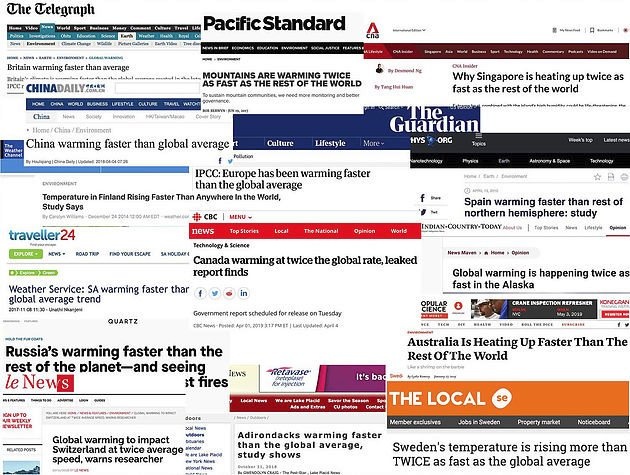
Apparently the climate change crisis is so bad that literally everywhere is heating twice as fast as the global warming average.

The Unseen Costs of Climate Alarmism Are Paid by the Global Poor - Foundation for Economic Education
Wealthier people are more able to cope with climate change and are overall less likely to die from all-natural causes than the very poor. Whatever the ill effects of climate change, the funds needed to keep people safe will be far more abundant in the future than they are now. //
Each of the UN’s Intergovernmental Panel on Climate Change (IPCC) reports, that guide our understanding of climate change, account for large leaps in worldwide wealth between 2000 and 2100. Even the poorest in the world—sometimes called “the Bottom Billion”—will be four to eighteen times as wealthy as they are today, according to the IPCC.
Wealthier people are more able to cope with climate change and are overall less likely to die from all-natural causes than the very poor. Whatever the ill effects of climate change, the funds needed to keep people safe will be far more abundant in the future than they are now. In the short term, the resources AOC claims must be used to fight distant climate change have more pressing alternative uses because people are poorer now than anyone will be then, even by IPCC’s somewhat dire predictions.
To demand sacrifice from the residents of developing countries—like paying higher prices for scarce food so some of it can be burned as biofuel—will do far more damage than a potential flood in 50 years, when the risk of starvation will be small. //
Even in the IPCC’s worst-case scenarios, those facing the harms of climate change in 100 years will be many, many times more prepared to deal with those harms than we are currently equipped to sacrifice in hopes of preventing them.
Climate data may be tainted by the fact that almost 90 percent of U.S. weather stations, which do not meet the National Weather Service’s location standards.
Recently there have been calls for tree planting on a colossal scale to capture CO2 and curb climate change. However, whilst young trees are efficient and effective carbon sinks, the same is not so true for mature trees. The Earth maintains a balanced carbon cycle – trees (along with all other plants and animals) grow using carbon, they fall and die, and release that carbon again.
Many pine trees in managed forests, such as the European spruce, take roughly 80 years to reach maturity, being net absorbers of carbon during those years of growth – but once they reach maturity, they shed roughly as much carbon through the decomposition of needles and fallen branches as they absorb. As was the case in Austria in the 1990s, plummeting demand for paper and wood saw huge swathes of managed forests globally fall into disuse. Rather than return to pristine wilderness, these monocrops cover forest floors in acidic pine needles and dead branches. Canada's great forests for example have actually emitted more carbon than they absorb since 2001, thanks to mature trees no longer being actively felled.
Arguably, the best form of carbon sequestration is to chop down trees: to restore our sustainable, managed forests, and use the resulting wood as a building material.