Baby Olme, who is expected to arrive in April 2023, has become one of the first babies in the Department of Defense to clock 9.2 hours in a supersonic aircraft.
As Maj. Lauren Olme, 77th Weapons Squadron assistant director of operations, fires up the engines of a B-1 Lancer on Dyess Air Force Base, she is living out her lifelong dream of being a pilot. In addition to that dream, she achieved a new feat that will impact future generations of servicewomen: Flying while pregnant.


Atlas Air flew home the last 747 ever produced on 1 February, marking the end of 747 deliveries from Boeing after 53 years.
A day after a gala ceremony fit for the Queen of the Skies the 747-8F registered N863GT thundered down Paine Field’s Runway 16R and lifted into the air to the awe of gathered onlookers. After a low pass at Paine, the flight headed east for Cincinnati, but not before drawing a special tribute to the 747.
En route from Everett to Cincinnati, the Atlas Air 747 took the time to draw a crown and “747” over eastern Washington. The 152 kilometer (94.5 mi) wide by 95.8 km (59.5 mi) high piece of sky art took 2 hours 35 minutes to complete at an altitude of 12,775 feet. The flight plan for this portion of the flight included 39 separate way points.
The final 747 delivery
The delivery of N863GT marks the final 747 to fly away from Everett after 1,574 model 747s came off the production line. From the first 747-100 to the shortened 747SP to the most successful variant, the 747-400, to the final 747-8, Boeing’s most iconic work has exited the building at Paine Field. The building will now be repurposed for 787 rework and a fourth final assembly line for the 737 MAX.
The accident investigation agencies disagree about what factors led to the 2019 crash of Ethiopian Airlines flight 302. //
The NTSB and the EAIB have differing opinions as to what caused the failure of MCAS and the subsequent Ethiopian crash.
“According to the EAIB’s final report, electrical problems that existed since the time of the accident airplane’s production caused the left angle-of-attack sensor heater to fail, which resulted in the AOA sensor providing erroneous values that caused the MCAS to pitch the nose of the airplane downward,” resulting in the crash, the NTSB report reads.
The NTSB report states that it found no evidence to support the suggestion of an electrical problem resulting in a nose-high attitude and failure of the MCAS, but suggests the faulty reading was “caused by the separation of the AOA sensor vane due to impact with a foreign object, which was most likely a bird.” //
There was no mention of MCAS issues in the pilot manuals when the Max entered service in 2017.
After the first crash, MCAS manuals were made available to 737 Max crews. Boeing stressed that MCAS was designed for better aircraft handling, not as a stall prevention tool.
After the second crash, the world’s 737 Max fleet was grounded for the better part of two years while changes were made to the MCAS software and training protocols were developed. The aircraft returned to service in November 2020.
The NTSB noted the EAIB issued its final report without giving the NTSB the opportunity to review new information incorporated since the NTSB’s last review and provide comments ahead of the report’s issuance, as stipulated by the International Civil Aviation Organization’s Annex 13.
The NTSB stated it had provided the EAIB with evidence supporting the bird contamination theory, but that evidence was not included in the EAIB final report.
The NTSB also noted the EAIB’s finding about the lack of MCAS documentation for flight crews was misleading since Boeing had provided the information to all 737 MAX operators four months before the Ethiopian Airlines crash.
Finding North Using an Analog Watch
The watch must be operational and the time accurate for this to work.
1) Lay the watch flat horizontally in your palm, with the watch face up.
2) Position the watch so the hour hand is pointing directly at the sun.
3) Note the angle between the hour hand and the 12 o’clock mark. The center of the angle marks the north-south line, with south on the side closest to the sun.
Please remember that this information is in standard time. Daylight Savings Time is a government construct that the universe does not follow; ergo, when the watch is set to DST, substitute 1 o’clock for 12 o’clock.
100LL is challenging to produce and distribute; it is a boutique fuel in terms of volume, hence why there is a limited number of producers. Avfuel, Epic, Titan, and others commonly swap stock to meet the ebb and flow of their stock levels.
Aviation fuel innovation is not widespread, and it is no wonder only a limited number of entities even attempt it. No new producers are on the horizon. Fear of negative press and the EPA keep them at bay. Some reports of an endangerment finding and pushing the 100LL ban out to 2030 have been making the rounds. Even now, as GAMI has approval, a total replacement of 100LL by 2030 would “be a challenge.”
Additionally, Europe is on the brink of banning tetraethyl lead (TEL), the chemical which adds lead to 100LL fuel. Distributors can still import blended 100LL fuel but at a very high price. At press time, the European Union Aviation Safety Agency (EASA) is evaluating the G100UL STC.
G100UL has no toxic chemicals nor organometallic additives (like TEL in 100LL). Scavenging agents, such as the ethylene dibromide required to try to scavenge the deposits formed by the TEL in 100LL, are also not found in GAMI’s product. Another thing missing is MMT (methylcyclopentadienyl manganese tricarbonyl), another organometallic additive with both engine deposits, as well as health and environmental concerns.
When the transition occurs, converting to G100UL will be seamless. Operators will not worry about separate tanks nor exhausting their supply of 100LL; the new unleaded fuel can store in the same tanks as legacy avgas.
G100UL offers additional benefits. The result of going unleaded is a cleaner fuel burn, no deposits forming in the combustion chamber, and no fouled plugs. All of the above spells reduced maintenance. Trust me; you will appreciate the reduction when you see my maintenance labor total on your next shop bill.
There aren’t many DC-8s left flying in the world today, but there’s one special airplane that is set to have an extended life in a very interesting role. NASA took on a Douglas DC-8 in February 1986 and has been operating it ever since as a flying science laboratory. Here’s what you need to know.
The National Aeronautics and Space Administration (NASA) is preparing to say goodbye to its old but iconic Douglas DC-8. NASA has operated the Douglas quadjet for decades, first taking it in February 1986, and using it ever since as a flying science laboratory.
The airplane was not new when it arrived with NASA, having originally been delivered to Alitalia in 1969 and flying with Braniff from 1979 until 1986. For NASA, it flies under registration N817NA, and is used to collect data for a range of experiments on behalf of the world’s scientific community, with operations costing scientists approximately $6,500 per hour.
NASA DC-8 flying science lab
Photo: NASA
The DC-8-72 is now approaching 54 years old, and despite being meticulously maintained by NASA, she is reaching the end of her useful life. As such, the Administration has lined up a replacement for the jet - a Boeing 777. //
The DC-8 is fast becoming a rare breed in terms of aircraft still flying. Just three airplanes are listed as being in active service today, the other two with Trans Air Cargo Service, according to ch-aviation. A further two are in maintenance just now, suggesting they could soon fly again. One operates for humanitarian purposes with Samaritan’s Purse, while the other is taken care of by SkyBus Cargo Charters.
NOTAM: Notice to Air Men (non PC)
"Notice to Air Missions"
Notices of Temporary changes in procedures at an airport or airspace, many end up being "permanent" and properly classified, so important info gets buried in the deluge.
Ops Group and ICAO want to reduce the number of codes in use and weed out the "permanent" notices so that appropriate notices can be prioritized and pilots only needs to be concerned with relevant notices, rather then wading through hundreds of pages looking for critical info, like it is now.
FAA type certification was awarded June 11, 1963, and Helio gave the Twin Courier a designation of H-500. Foreseeing military use, the U.S. Air Force assigned the designations U-5A and U-5B to the naturally-aspirated and turbocharged versions, respectively. But despite the certification and preparation, only seven examples would ever be produced. //
The operational history of these seven aircraft is as unique as their appearance. While Helio publicly stated that all Twin Couriers were delivered to the CIA, they would go on to operate in clandestine operations under various entities of the U.S. military and government. Over their operational lives, some would be given USAF markings, while others would wear civilian paint schemes and civilian registration numbers. The N-numbers were registered to entities speculated to be shell companies for the CIA. //
Dr. Joe F. Leeker of the University of Texas, Dallas, has compiled what might be the most comprehensive history of the Twin Courier. In it, he traces the progression of each airframe through its respective history, noting that they saw service in Nepal, Bolivia, Peru, and the U.S. before being transferred to—and disappearing in—India. From there, the trail goes cold, and no Twin Couriers are known to exist today.
We can speculate, however. Given the rugged, remote areas in which the aircraft were known to operate, demanding airstrips and conditions likely claimed more than one aircraft. //
Considering the clever engineering and intriguing history of the Twin Courier, it’s unfortunate none exist today to be admired in person by future generations. Despite being certified by the FAA, it’s unlikely more will ever be built.
Just before the end of the year, Ethiopian investigators published their final report on the crash of Ethiopian Airlines flight ET302. Flight 302 crashed shortly after takeoff from Addis Ababa Bole Airport on 10 March 2019. Operated by Boeing 737-8 MAX ET-AVJ, it was the second crash of a 737 MAX in just over four months and led to a worldwide 20 month grounding of the MAX while Boeing and regulators made changes to the aircraft.
Following the publication of the final report, both the US National Transportation Safety Board (NTSB) and French Bureau d’Enquêtes et d’Analyses (BEA) took the highly unusual step of publishing separate comments on the report.
Ethiopian investigators’ probable cause: MCAS
In their final report, Ethiopian investigators solely focus on the activation of the Maneuvering Characteristics Augmentation System as the probable cause of the accident.
Sec. 5604 of the James M. Inhofe National Defense Authorization Act for Fiscal Year 2023 specifically addresses the issue:
"A flight instructor, registered owner, lessor, or lessee of an aircraft shall not be required to obtain a letter of deviation authority from the [FAA administrator] to allow, conduct, or receive flight training, checking and testing in an experimental aircraft if 1) the flight instructor is not providing both the training and the aircraft; 2) no person advertises or broadly offers the aircraft as available for flighty training, checking, or testing; and 3) no person receives compensation for use of the aircraft for a specific flight during which flight training, checking, or testing was received, other than expenses for owning, operating, and maintaining the aircraft."
With the president's signature, experimental aircraft owners may resume receiving instruction in their aircraft without having to jump through this frustrating hoop.
The flight took off at about 9:24 p.m. on 20 February 2005. When the aircraft, a four-engine Boeing 747-436, was around 300 feet (91 m) into the air, flames burst out of its number 2 engine, a result of engine surge. The pilots shut the engine down. Air traffic control expected the plane to return to the airport and deleted its flight plan.[citation needed] However, after consulting with the airline dispatcher, the pilots decided to set off on their flight plan "and get as far as we can" rather than dump 70 tonnes of fuel and land. The 747 is certified to fly on three engines. Having reached the East Coast, the assessment was that the plane could continue safely. The cross-Atlantic journey encountered less favourable conditions than predicted. Upon reaching the UK, believing there to be insufficient usable fuel to reach their destination, the captain declared an emergency and landed at Manchester Airport.
A safety controversy ensued; the US Federal Aviation Administration (FAA) accused the carrier of flying an "unairworthy" plane across the Atlantic Ocean. The FAA proposed fining the carrier, British Airways (BA) $25,000. BA lodged an appeal on the grounds that they were flying according to United Kingdom Civil Aviation Authority (CAA) rules (which are derived from International Civil Aviation Organization standards).
Spitfire SurpriseSpitfire Mark IX MH434 is one of the most famous of today's flying Spitfires and is a combat veteran of WW2 and post war conflicts.
On this day, 19th July 1996, the pilot Ray Hanna decided to scare a TV documentary crew to death by taking off, hugging the ground, and pouncing on the crew while they recorded a link for a documentary on the 60th Anniversary of the Spitfire for American TV. I had a camera with me on the day - I was producing the TV crew - and looking for the aircraft through my lens it suddenly appeared and I clicked the shutter before dropping to the ground. The video of the moment is on Youtube with copious expletives (https://youtu.be/4iOoiEbtf2w) if you want to see what happened. https://www.youtube.com/watch?v=brd44OS0Ueo
Ray Hanna was one of the best warbird pilots of his generation, formerly in the Royal Airforce he had been leader of the aerobatic display team the Red Arrows and once he became a pilot of classic aircraft he and MH434 were the go to team for numerous Hollywood film directors.
When it came to low flying stunts Ray was the best there was and the secret was decades of experience with the aircraft, faultless expertise and meticulous preparation. As for my photo, that was luck...
Martin Stockham 1996 and 2016
The final Boeing 747 rolled out of the assembly building in Everett, Washington this week, capping a 54 year production run for the iconic Queen of the Skies. The final 747, line number 1574, will be delivered to Atlas Air in early 2023. While the 747 is no longer in production, it is still busy flying passengers and cargo around the world.

For some of us, few things get the nostalgia flowing like vintage airline advertisements. This one is from Gourmet magazine, of all places, in 1976.
There’s a lot to pull from here…
For starters, looking at the collage of tails, we spy three classic carriers that no longer exist: Sabena, Swissair, and of course Pan Am. Of all the many airlines that have gone out of business, few were more historically significant than these three.
The ad also celebrates the advent of the Boeing 747SP — the short-bodied, long-range 747 variant that debuted in the mid-1970s. This focus on aircraft type is a hallmark of older ads and something rarely seen any more. When was the last time an airline spent advertising dollars to boast about a particular plane? It made sense in the 1970s, when models were vastly different from one another and some, like the 747 or Concorde, were media stars. Nowadays, with jets so tediously similar, carriers don’t bother and passengers couldn’t care less.
With that in mind, notice that every tail in that panel except for one features a 747. The single exception is the Aeroflot image, which shows an Ilyushin IL-62. These were the days when you could be at Kennedy Airport and watch ten or more 747s take off in a row.
And, of course, the whole premise of the ad — Iran Air showcasing a new link between Tehran and New York — is itself striking. How things change. Iran in 1976 was still three years away from its revolution, and the country’s national carrier was a regular visitor to New York.
Neither did they shy away from including an El Al tail (top row, third one in) up there with the others. This implies that El Al offered a connecting service to Tehran from New York, presumably via Tel Aviv, which is maybe the most remarkable aspect of the entire page.
WHAT BOEING NEEDS to build isn’t a fancy new long-range widebody. What it needs to build is a replacement for the 757.
When it debuted in the early 1980s, the twin-engined 757 was ahead of its time, and it went on to sell quite well until the production line closed fifteen years ago. By now the plane is — or should be — obsolete. Indeed it’s rare to spot a 757 outside of the United States. But here at home it remains popular, a mainstay of the fleets at United, Delta, FedEx and UPS, who together operate over two-hundred of them. They’ve kept the plane on their rosters so long for good reason: its capabilities are unmatched, and there’s nothing that can replace it.
The 757 is maybe the most versatile jetliner Boeing has ever built — a medium-capacity, high-performing plane that is able to turn a profit on both short and longer-haul routes — domestic or international; across the Mississippi or across the North Atlantic. The 757 makes money flying between New York and Europe, and also between Atlanta and Jacksonville. United and Delta have flown 757s from their East Coast gateways on eight-hour services to Ireland, Scandinavia, and even Africa. You’ll also see it on 60-minute segments into Kansas City, Cleveland, and Tampa.
Along the way, it meets every operational challenge. Short runway? Stiff headwinds? Full payload? No problem. With 180 passengers, the plane can safely depart from a short runway, climb directly to cruise altitude, and fly clear across the country — or the ocean. Nothing else can do that.
November 12, 2021
WE MADE IT. I had my doubts, but we pulled it off.
Today marks the 20th anniversary of the crash of American Airlines flight 587 in New York City. We have now gone twenty full years since the last large-scale crash involving a major U.S. carrier. This is by far the longest such streak ever.
On the sunny morning of November 12th, 2001, American 587, an Airbus A300 bound for the Dominican Republic, lifted off from runway 31L at Kennedy Airport. Seconds into its climb, the flight encountered wake turbulence spun from a Japan Airlines 747 that had departed a few minutes earlier. The wake itself was nothing deadly, but the first officer, Sten Molin, who was at the controls, overreacted, rapidly and repeatedly moving the widebody jet’s rudder from side to side, to maximum deflection. The rudder is a large hinged surface attached to the tail, used to help maintain lateral stability, and Molin was swinging it back and forth in a manner it wasn’t designed for. Planes can take a surprising amount of punishment, but airworthiness standards are not based on applications of such extreme force. In addition, the A300’s rudder controls were designed to be unusually sensitive, meaning that pilot inputs, even at low speeds, could be more severe than intended. In other words, the pilot didn’t realize the levels of stress he was putting on the aircraft. The vigor of his inputs caused the entire tail to fracture and fall off.
Quickly out of control, the plane plunged into the Belle Harbor neighborhood of Queens, a skinny section of Rockaway only a few blocks wide, with ocean on both sides. All 260 passengers and crew were killed, as were five people on the ground. It remains the second-deadliest aviation accident ever on U.S. soil, behind only that of American flight 191 at Chicago, in 1979. //
What we haven’t seen, however, is the kind of mega-crash that was once brutally routine, year after year. Take a look through the accident archives from 1970s through the 1990s. Seldom would a year go by without recording one or more front-page mishaps, with 100, 200, sometimes 300 (or more) people killed at a time. In the eighteen years prior to November, 2001, and not counting the September 11th attacks, the American legacies, which at the time included names like Pan Am, TWA and Eastern, suffered ten major crashes. The idea that we could span two full decades without such a disaster was once unthinkable.
It’s especially remarkable when you consider there are nearly twice as many planes, carrying twice as many people, as there were in 2001. Since then, the mainline American carriers have safety transported more than twenty billion passengers. Today they operate over four thousand Airbuses and Boeings between them, completing tens of thousands of flights weekly. The streak also takes in those dark years of the early 2000s, when pretty much all of the big carriers were in and out of bankruptcy, fighting for survival. Not to mention the dire challenges of the last twenty months, brought on by the COVID-19 pandemic. Best of times, worst of times. All it would have taken is one screw-up, one tragic mistake. Yet here we are. //
How we got here is mainly the result of better training, better technology, and the collaborative efforts of airlines, pilot groups, and regulators. We’ve engineered away what used to be the most common causes of accidents. Yes, we’ve been lucky too, and the lack of a headline tragedy does not mean we should rest on our laurels. Complacency is about the worst response we could have. Air safety is all about being proactive — even a little cynical. Our air traffic control system needs upgrades, our airports need investment. Terrorism and sabotage remain threats, and regulatory loopholes need closing. The saga of the 737 MAX has been a cautionary window into just how fortunate we’ve been, and exposed some glaring weaknesses.
Duly noted, but a congratulatory moment is, for today, well earned. This isn’t a minor story.
Almost nobody in the media is paying attention, trust me. Crashes, not an absence of them, make the news. Call it the silent anniversary, but there’s no overstating it: we have just passed one of the most significant milestones in commercial aviation history.
U.S. Airline Accidents With 50 or More Fatalities, by Year

THE TIMELINE of an aviation career, for some of us, is punctuated with dark occurrences. Furloughs, rejection letters, bankruptcies. And now, sigh, I’ve lost my beloved calculator.
I bought the thing 23 years ago, if I remember right, at the old Osco store on Highland Avenue near Davis Square. It was your basic flip-top model, dual solar and battery, with fat buttons and an oversized screen for better low-light viewing. I paid about four dollars for it.
When you own anything for 23 years, you grow fond of it. //
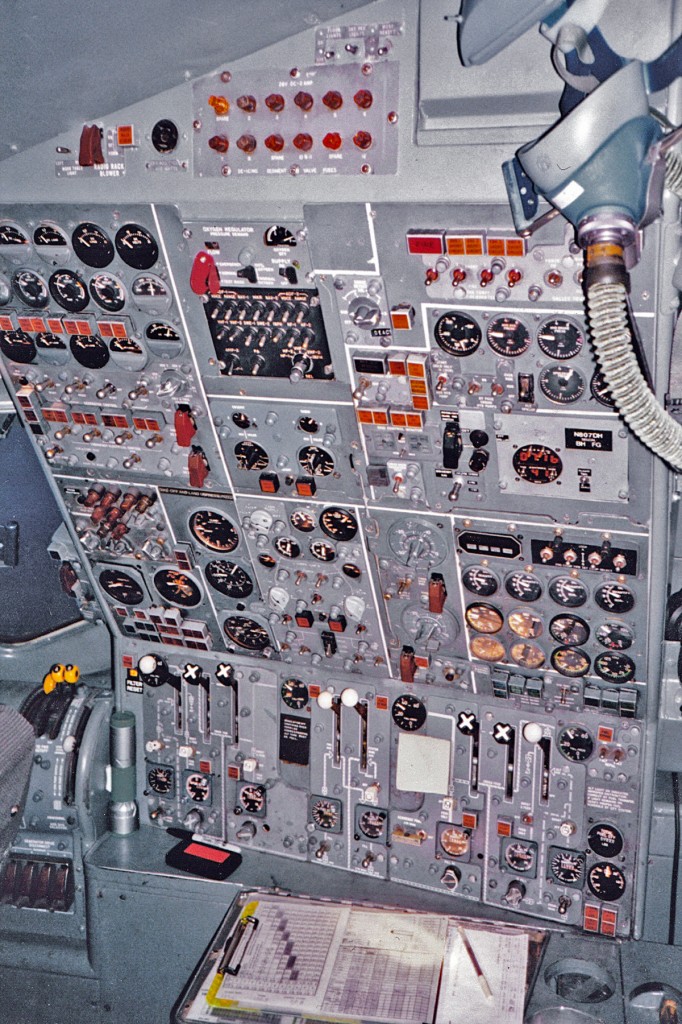
You can see the calculator in the picture below, taken in 1998. No, that’s not a U-boat circa 1944; it’s the flight engineer’s station of a Douglas DC-8. This was my office for about four years, shuttling cargo to and from Europe and across the U.S. The calculator is on the ledge, lower left. Notice it has an orange sticker on its case. I added the sticker for the same reason that I use a bright red bumper on my iPhone: to keep me from leaving it behind. So much for bright ideas, literally.
The calculator was a necessary instrument on the ancient Douglas. The weight, balance, and fuel calculations were all done by hand. It was simple arithmetic, but these were big, six-digit numbers. Not so much on the 767. It’s the dispatchers, loaders and planners who do all the serious number-crunching. They upload the results to us and we plug them in. About the only things we calculate manually are the waypoint crossing times and maybe the start/end times of our crew rest breaks. This is hardly anything technical; they’re just figures of convenience jotted down in the margins of the flight plan, requiring nothing more than adding or subtracting a few simple numbers.