- Create a new file, e.g.
delrecycle.sh
Enter the following content todelrecycle.sh:
     #!/bin/sh
     find /mnt/[MountPoint]/.recycle/* -atime +[Age] -exec rm -rf '{}' \;
find /mnt/[MountPoint]/.recycle/ -depth -type d -empty -exec rmdir {} \;- Adjust
[MountPoint](mount point of your share) and[Age](age of the files in days which you want to erase) to your environment and needs. - Upload
delrecycle.shto your share. - Create a
cronjob(System|Advanced|Cron) withroot– privileges, which calls the command:
sh /path/to/MountPoint/delrecycle.sh


Storage Boxes provide you with safe and convenient online storage for your data. Score a Storage Box from one of Hetzner Online's German or Finnish data centers!
Storage: 1 TB
Traffic: Unlimited
Monthly: € 3.20
- € 0.00 once-off setup fee
Server hardware can be reused even if a product is terminated. This is reasonable in terms of both economic and ecological aspects. Benefit from this advantage.
The server auction not only markets standardized server systems such as those found in our product portfolio but also customized systems that were adapted to customer requirements in the past. Therefore automatic image installers, special software images, the vKVM or other software systems are not possible. To ensure a seamless installation and functionality, the server is delivered in the rescue system.
from € 32.00
DEDICATED ROOT SERVER
SELECT A SERVER IN SECONDS
Configure your dream server.
Simply enter which hardware you would like.
from € 37.30
An alternative to Big Tech's video platforms
PeerTube is a tool for sharing online videos developed by Framasoft, a french non-profit.
What is PeerTube?
PeerTube allows you to create your own video platform, in complete independence.
Dans le but de promouvoir la décentralisation des données personnelles et l’usage de logiciels open source, je propose un hébergement de divers services utiles. Ces services sont basés sur du code libre et déployés sur des systèmes libres également.
Je suis un particulier, et dans la mesure de mes capacités, j’essaye toujours de fournir des services à ma famille et à mes amis proches en remplacement de services non libres fournis par les géants du web. J’ai décidé de faire le nécessaire pour étendre ces services à un public plus large, avec pour but de conserver une qualité suffisante.
Hive Systems - Time it takes a hacker to brute force your password (2022)
The numbers don’t lie! We’ve updated this table by Mike Halsey, Microsoft MVP, since hackers are getting faster. If you’re using a weak password, you can say goodbye to your money or social media account!
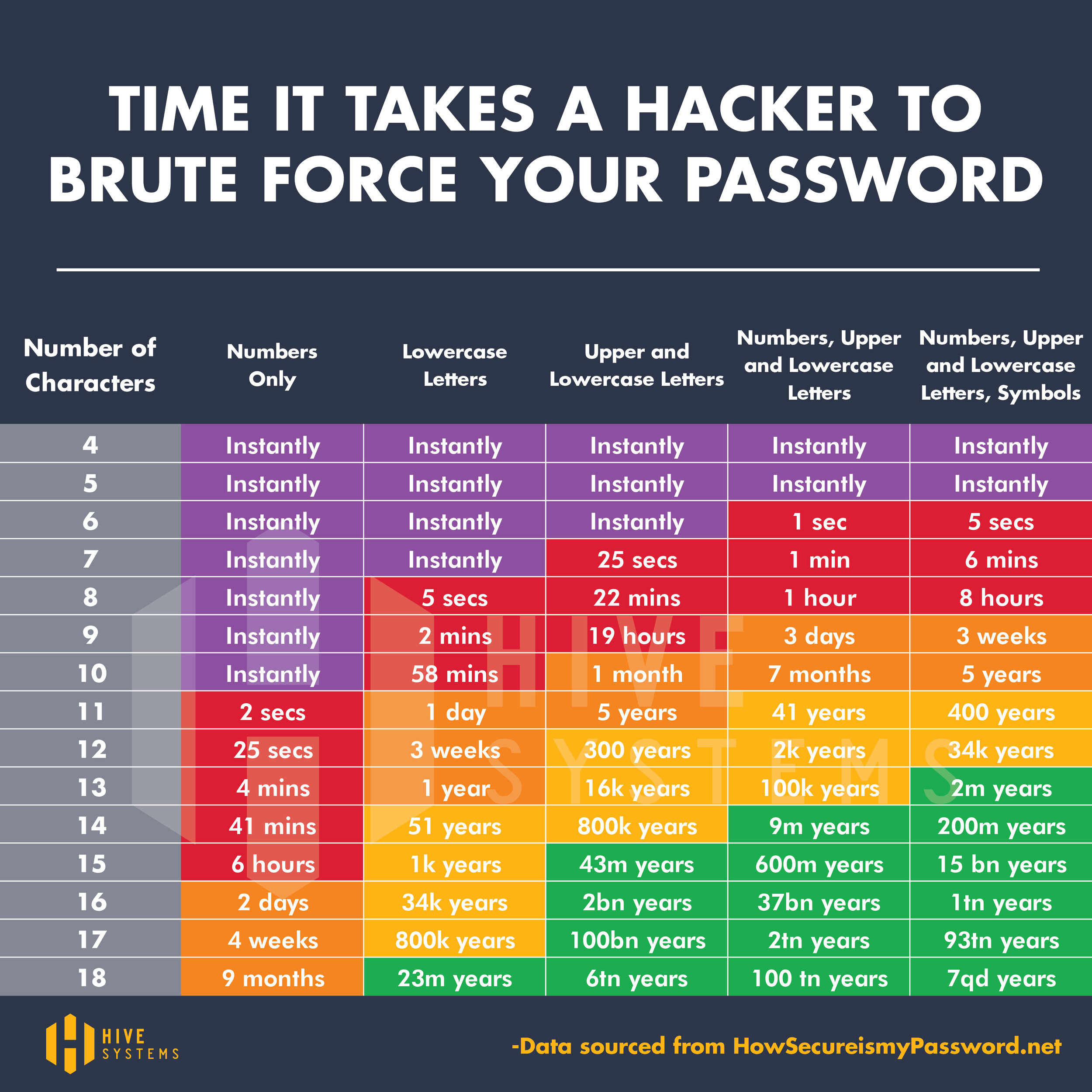
Hive Systems - Time it takes a hacker to brute force your password (2020)

The 2022 update to our famous Hive Systems Password Table that’s been shared across the internet, social media, the news, and organizations worldwide. So what’s new, and what’s our methodology behind it?
Generate long passwords that are easy to remember.
Inspired by the xkcd comic.
Hasselblad and NASA’s journey together began in 1962 during the Mercury program. Prospective NASA astronaut and photography enthusiast Walter Schirra had his own Hasselblad 500C with a Planar f/2.8, 80mm lens. Knowing the high quality of the Hasselblad camera, Schirra suggested to NASA that they use a Hasselblad to document space since the previous camera model utilised delivered disappointing results. After buying a few 500Cs, a weight-loss program followed including removal of its leather covering, auxiliary shutter, reflex mirror, and viewfinder. A new film magazine was constructed in order to allow for 70 exposures instead of the usual 12. Finally, a matte black outer paint job minimized reflections in the window of the orbiter. The streamlined Hasselblad would find itself in the payload for Mercury 8 (MA-8) in October 1962. The successful, high quality images that Schirra captured across his six orbits of the Earth would spark a new chapter in the history of Hasselblad and a long, close and mutually beneficial cooperation between the American space agency and the Swedish camera manufacturer.
What kinds of contracts might not hold up in court?
Since a contract is a legally binding agreement, in the typical scenario, once you enter into a contract with another person or business, you and the other party are both expected to fulfill the terms of the contract. But it's possible for an otherwise valid contract to be found unenforceable in the eyes of the law, and this article looks at some common situations where that might be the case. //
Contracts can be found unenforceable on grounds of public policy not only to protect one of the parties involved, but also because what the contract represents could pose harm to society as a whole. For example, a court will never enforce a contract promoting something already against state or federal law (you can never enforce a contract for an illegal marijuana sale) or an agreement that offends the "public sensibilities" (contracts involving some sort of sexual immorality, for example).
JPL's Exoplanet Travel Bureau presents: Visions of the Future
Imagination is our window into the future. At NASA/JPL we strive to be bold in advancing the edge of possibility so that someday, with the help of new generations of innovators and explorers, these visions of the future can become a reality. As you look through these images of imaginative travel destinations, remember that you can be an architect of the future.

Swindon, England, is home to what may be the most confusing-looking intersection ever created: the world’s first “magic roundabout” (also known as a “ring junction”).
The complex interchange actually consists of five separate smaller roundabouts supporting clockwise traffic, all situated around one larger central roundabout that runs counterclockwise.
Despite its frightening appearance, this configuration is far more efficient than the conventional single-ring roundabout. It has been adapted to create other ring junctions around Britain.
It’s difficult to pin down the exact number of buildings in New York City. One source estimates 860,000, another source pins the number at 1,053,713. Whatever the number, we’ll know eventually, thanks to Australian-born James Gulliver Hancock, who has made it his mission to draw every single one of them.
Here’s his story:
When I moved to New York City, I really wanted to get to know Manhattan better, beyond a traditional tourist experience. New York was my new home, and I needed a way to understand it. Drawing every building is my version of a diary of my experience in the city—and it doubles as my own personal map. When I walk by the buildings I’ve drawn, it’s like seeing old friends.
If I’d set out to draw all the best buildings or all the brick ones, I’d wind up having that tourist experience I was trying to avoid. I really like the concept of just all the buildings. By concentrating on the city at large, I get to embrace all the fun buildings between the famous ones, like a crumbling brownstone or that weird falling-apart one I pass every day. Going all out provides me with a more realistic view of the city.
I’m actually not sure how many buildings there are in New York City. The number 900,000 comes up a lot though. I draw, on average, four buildings in a week, so it’s a long-term project to be sure. [Editor’s note: By our tally, this means James is about 1,100 buildings in. Maybe he’ll pick up the pace!]
You might have noticed there’s something wrong with this bike. Or you might have not.
This bicycle is missing a very important part of its frame and it would immediately break if it actually existed and someone tried to ride it.
Let me explain everything from the beginning:
back in 2009 I began pestering friends and random strangers. I would walk up to them with a pen and a sheet of paper asking that they immediately draw me a men’s bicycle, by heart. Soon I found out that when confronted with this odd request most people have a very hard time remembering exactly how a bike is made. Some did get close, some actually nailed it perfectly, but most ended up drawing something that was pretty far off from a regular men’s bicycle.
Little I knew this is actually a test that psychologists use to demonstrate how our brain sometimes tricks us into thinking we know something even though we don’t.
I collected hundreds of drawings, building up a collection that I think is very precious. There is an incredible diversity of new typologies emerging from these crowd-sourced and technically error-driven drawings. A single designer could not invent so many new bike designs in 100 lifetimes and this is why I look at this collection in such awe. //
In early 2016 I eventually decided it was my turn to take part in this project.
I decided my job was going to be presenting the potential and the beauty inside these sketches. I selected those that I found most interesting and genuine and diverse, then rendered them as if they were real. I became the executor of these two minute projects by people who were mainly non-designers and confirmed my suspicion: everyone, regardless his age and job, can come up with extraordinary, wild, new and at times brilliant inventions.
If you're confused, don't worry; you're in good company; even security "experts" don't understand the comic:
- Bruce Schneier thinks that dictionary attacks make this method "obsolete", despite the comic assuming perfect knowledge of the user's dictionary from the get-go. He advocates his own low-entropy "first letters of common plain English phrases" method instead: Schneier original article and rebuttals: 1 2 3 4 5 6
- Steve Gibson basically gets it, but calculates entropy incorrectly in order to promote his own method and upper-bound password-checking tool: Steve Gibson Security Now transcript and rebuttal
- Computer security consultant Mark Burnett almost understands the comic, but then advocates adding numerals and other crud to make passphrases less memorable, which completely defeats the point (that it is human-friendly) in the first place: Analyzing the XKCD Passphrase Comic
- Ken Grady incorrectly thinks that user-selected sentences like "I have really bright children" have the same entropy as randomly-selected words: Is Your Password Policy Stupid?
- Diogo Mónica is correct that a truly random 8-character string is still stronger than a truly random 4-word string (52.4 vs 44), but doesn't understand that the words have to be truly random, not user-selected phrases like "let me in facebook": Password Security: Why the horse battery staple is not correct
- Ken Munro confuses entropy with permutations and undermines his own argument that "correct horse battery staple" is weak due to dictionary attacks by giving an example "strong" password that still consists of English words. He also doesn't realize that using capital letters in predictable places (first letter of every word) only not increases password strength by a bit (figuratively and literally): CorrectHorseBatteryStaple isn’t a good password. Here’s why.
Sigh. 🤦♂️
password testing
One of the reasons why I advocated for an XKCD-like scheme (before it got called that) in Toward Better Master Passwords back in 2011 is precisely because its strength does not rely on the attacker knowing what scheme you used. If I may quote myself
The great thing about Diceware is that we know exactly how secure it is even assuming that the attacker knows the system used. The security comes from the genuine randomness of rolling the dice. Using four or five words should be sufficient against the plausible attacks over the next few years given observed speed of password crackers [against 1Password Master Password]
What the XKCD comic does not effectively communicate is that the selection of words must be (uniformly) random. If you ask humans to pick words at random, you get a heavy bias for concrete nouns. Such biases can and will be exploited.