Long before Beto O’Rourke claimed the world only had 10 years left for humans to act against climate change, alarmists had spent decades predicting one doomsday scenario after another, each of which stubbornly failed to materialize. It seems climate armageddon has taken a permanent sabbatical.
Many of those doomsday predictions specifically mentioned the annus horribilus of 2020. Those predictions also failed, some rather spectacularly.
Steve Milloy, a former Trump/Pence EPA transition team member and founder of JunkScience.com, compiled ten climate predictions for 2020 that fell far off the mark.
-
Average global temperature up 3 degrees Celsius
-
Global emissions
the CO2 in the atmosphere hasn’t come close to doubling since 1978. According to NOAA, in March 1978 when the Sun published this article, there were 335 parts per million of CO2 in the atmosphere. In February 2020, NOAA reported 413 parts per million in the atmosphere. That represents an increase of 23 percent, a far cry from doubling the concentration (which would be 670 parts per million).
- Emissions from India and China.
According to the World Bank, India emitted 1.2 million kilotons of CO2 in 2005 and 2.4 million kilotons of CO2 in 2018, the last year data is available, a 200 percent increase. China, meanwhile, emitted 5.9 million kilotons in 2005 and 9.9 million kilotons in 2016, a 168 percent increase.
-
No snow on Mount Kilimanjaro
-
Rising sea levels in the Sunshine State
According to NOAA, the sea level at Virginia Key has risen by about 9 centimeters, which works out to 3.54 inches.
-
People will become unfamiliar with snow
-
Pacific islands economies devastated
-
Global conflict and nuclear war
-
The end of Arctic ice
In April 2013, the Lancaster Eagle-Gazette reported that NOAA scientists predicted “ranges for an ice-free Arctic from 2020 to after 2040.”
- Glaciers gone at Glacier National Park
In March 2009, U.S. Geological Survey ecologist Daniel Fagre predicted that the glaciers in Montana’s Glacier National Park would disappear by 2020.
Princeton’s Net Zero America: Potential Pathways, Infrastructure and Impacts charts five challenging, tortuous, investment-intensive paths to “net-zero” by 2050. A presentation that contains 345 slides of text, colorful graphs and wide area maps provides details about the selected scenarios. The Princeton research team promises peer-reviewed journal articles in the near future.
According to sponsor organization promotional materials, the slide deck was released before the journal articles “in recognition of the urgency to cut greenhouse gas emissions and the need for immediate federal, state, and local policy making efforts.” There’s little doubt that the project sponsors and the authors have a strong policy-influence agenda.
All five chosen scenarios involve technology and infrastructure deployments “at historically unprecedented rates across most sectors.” They represent “expansive impacts on landscapes” that have not yet been planned in communities whose permission has not yet been obtained.
Overlooked path
The NZA study ignores a straight, wide, blazed trail. As documented in Goldstein and Qvist’s 2019 book titled A BRIGHT FUTURE: How Some Countries Have Solved Climate Change and the Rest Can Follow, several major electricity grids have successfully eliminated coal and been nearly completely decarbonized.
In those grids–France, Sweden, and Ontario–a combination of nuclear power and hydroelectricity did the job. In each case, it took about two decades of sustained effort.
None of history’s successful decarbonization efforts required a complete reordering of the economy. The nuclear energy portion of the country- or providence-wide efforts that now provide reliable, abundant electricity from non-combustion sources that do not dump carbon dioxide to the environment did not result in “expansive impacts on landscapes.”
Electricity can do most of the work
Though electricity is only a part of total energy use, the Princeton study makes the reasonable assumption that decarbonized electricity grids can be expanded to supply the energy services needed to decarbonize most of the rest of the energy supply.
That same assumption continues to work if the electricity decarbonization path includes a successful effort to improve nuclear energy products and projects. Unlike wind and solar, atomic energy is a thermal energy source that can directly supply heat energy useful for industrial processes. Some of the electrification expansions that NZA assumes to be necessary to supply all energy demands might be accomplished more affordably with direct heat use.
AOC and the hard-left want the very socialistic Green New Deal to be pushed through so badly they’ll lie their heads off to make it happen and if it means scaring the population into compliance then so be it.
You’ll never see AOC show up to debate anyone about it. It’s clear the ramifications of the Green New Deal would scare the population even more than the left’s climate scaremongering. Better to tell everyone that we’re about to hit the point of no return and make them climate issue voters.
Only once again, the deadline’s come and gone, and everything is great. The only thing burning up is the left’s climate narrative.
The comments by Kerry come from a panel discussion hosted by the World Economic Forum earlier in November, following the 2020 election. The host of the panel is Borge Brende, the president of the World Economic Forum, an organization that has thus far devoted more time and money to promoting the Great Reset than any other group in the world.
These quotes are noteworthy for a number of reasons, but perhaps the most important is that Kerry makes it clear that Biden himself supports the Great Reset and that under a Biden administration, the reset “will happen with greater speed and with greater intensity than a lot of people might imagine.” //
put squarely in front of a lot of these CEOs the issue of stakeholder versus shareholder—which is really at the bottom of what I was talking about, about the dysfunctionality of government and the reaction of citizens. It’s shareholder versus stakeholder. And the issue is whether or not we’re going to move fast enough to provide for what people need at this moment. I think the greatest opportunity we have to do that is in dealing with the climate crisis. … //
“ESG [environment, social, and governance standards] is now in every discussion in every board room. Many, many more financial institutions are looking for what was fashionably called ‘impact investing,’ but everybody is now considering how do we have an impact that’s positive and meet ESGs. The global development standards, the SDGs [U.N. Sustainable Development Goals] are being talked about more.”
Kerry finishes by talking about Joe Biden’s commitment to rejoin the Paris Climate Agreement and Biden’s plans to impose carbon-dioxide restrictions.
SOURCE: John Kerry’s remarks at “The Great Reset: Building Future Resilience to Global Risks,” World Economic Forum, weforum.org, November 17, 2020, https://www.weforum.org/agenda/2020/11/the-great-reset-building-future-resilience-to-global-risks. (Remarks begin just before the 26-minute mark.)
Dungeness B nuclear power station, which is in Dungeness nature reserve on the south coast, is home to numerous species and rare habitats. Visitors to this area will find Dungeness Bird Observatory in the shadow of the nuclear power station, and yet this same area is also popular with the Jack Snipe, Sandwich Tern, Peregrine Falcon, Black Redstart, Kittiwake and many more diverse and rare birds. Ecologists have found the Brown Carder Bee Bombus humilis, a species that Buglife and the Bumblebee Conservation Trust get excited about, within 0.5km of the power station. People also live happily next to the power plant. Despite what the RSPB claims will come to pass if Sizewell C is built, the area around Dungeness power plant is actually teeming with life.
Why is wildlife around nuclear power stations actually thriving?
One reason is that these sites often lead to habitat creation and increased protection, for example reptile mitigation strategies at Sizewell C when it goes ahead. I spoke to independent wildlife consultant Jonathan Cranfield about this. “Nuclear power comes with plenty of room for biodiversity, semi natural habitats and wildlife,” he told me. “The construction of Sizewell C offers significant opportunities for rewilding, habitat creation and management. It’s vital for local biodiversity gains, as it brings with it extensive ecological monitoring, plus clean and reliable power for millions of people. Several power stations around the country are in fact places that rare birds like peregrines call home.” //
On its website the RSPB states that: “our campaigning is underpinned by expert analysis, practical demonstration and conservation delivery — but we campaign as vigorously as we always did to ensure the next generation can enjoy wildlife as we do.” However, their stance on nuclear power shows the opposite to be true.
Just last year the RSPB approved a gas power station on its Saltholme reserve, 100 metres from a Site of Special Scientific Interest (SSSI) in Stockton. The charity appears to support gas, while opposing 30 energy projects in the UK, including onshore and offshore wind, wave and tidal projects, carbon capture storage (CCS) and nuclear.
As the planet warms, we will lose more and more species, many of them birds, unless we reduce our greenhouse gas emissions rapidly. We cannot do this without new nuclear.
Evidence shows that nuclear is much safer than the alternatives that we currently depend upon. The Sizewell B nuclear plant, which I visited this summer for a swim, is a beautiful place that is surrounded by wildlife. It’s rare that we hear the success stories of nuclear and nature, but consider the story of the manatees in Florida that benefited from the warm water around the Crystal River nuclear plant so significantly that when the plant was decommissioned marine biologists worried that the numbers of manatees would decrease.
I have come to accept that my previous advocating for 100% renewables (something that The Green Party, which I am no longer a member of, still does) is not based on science. Germany has invested heavily in renewable technologies while phasing out its nuclear plants, but research has found that it will have the EU’s fourth most carbon intensive electricity grid by 2030. If their energy experiment had succeeded, I’d be advocating for it.


Today, shortly after giving expert testimony to Congress about energy policy, I had the startling experience of being smeared by sitting members of the United States House of Representatives.
The context was a special House Committee hearing to evaluate a Democratic proposal similar to the one proposed by Democratic presidential candidate Joe Biden, which would spend $2 trillion over four years on renewables and other climate programs.
Congressional interest in my testimony stems in part from the fact that I advocated for a Democratic energy proposal very similar to Biden’s between 2002 and 2009. Back then, the Obama administration justified the $90 billion it was spending on renewables as an economic stimulus, just as Biden’s campaign is doing today.
But then, late in the hearing, Representatives Sean Casten of Illinois and Jared Huffman of California, both Democrats, used the whole of their allotted time to claim that I am not a real environmentalist, that I am not a qualified expert, and that I am motivated by money.
Had I been given a chance to respond, I would have noted that: I have been a climate activist for 20 years; my new book, Apocalypse Never, has received strong praise from leading environmental scientists and scholars; the United Nations Intergovernmental Panel on Climate Change recently invited me to serve as an expert reviewer; and that I have always been financially independent of industry interests.
But I wasn’t given the chance to say any of that. After Casten and Huffman lied about me, Rep. Garret Graves asked the committee’s chairperson, Rep. Kathy Castor of Florida, to let me respond. She refused and abruptly ended the hearing.
What, exactly, had I said that was so dangerous as to lead Democrats to engage in character assassination and undermine liberal democratic norms? Nothing I hadn’t already said last January when I testified before Congress about climate change and energy.
Back then, I testified that climate change is real but isn’t the end of the world nor even our most important environmental problem. I pointed to the inherent physical reasons renewables can’t power a high energy industrial civilization. And I noted that cheap and abundant natural gas and nuclear, not industrial solar and wind, have been the big drivers of emissions reductions.
I further made the case that climate change was distracting us from a far greater and more urgent threat, which is the global domination of nuclear energy by China and Russia, which could be disastrous for US interests and the future of liberalism and democracy around the world.
Nations that partner with Russia or China to build nuclear plants are effectively absorbed into their sphere of influence. The line between soft power and hard power runs through nuclear energy. On the one side is cheap and clean electricity. On the other, a stepping stone to a weapons program.
During today’s hearing, several Democratic members claimed that renewables today are cheaper than existing grid electricity. But if that were true, I replied, why do solar and wind developers require hundreds of billions of dollars from American taxpayers in the form of subsidies?
The Democrats are basing their climate agenda on what California did. But California’s electricity rates since 2011 rose six times more than they did in the rest of the US, thanks mainly to the deployment of renewables and the infrastructure they require, such as transmission lines.
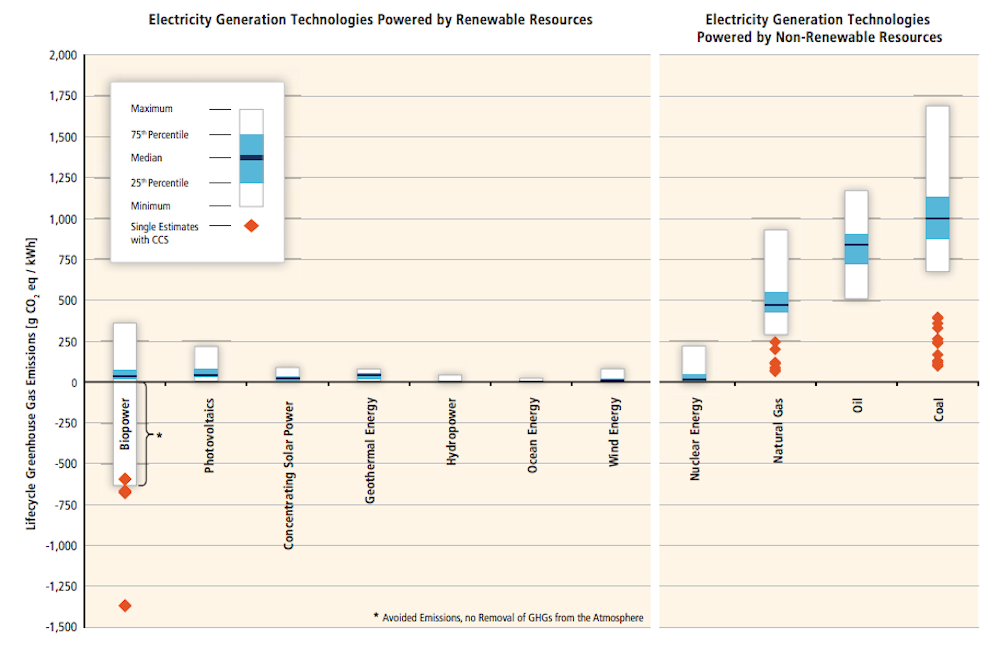
How nuclear stacks up against other energy sources in terms of life-cycle emissions. IPCC Special Report on Renewable Energy Sources and Climate Change
This shows that despite the long list of stages at which greenhouse gases are emitted, and based on what researchers have been able to take into account so far, the overall life-cycle emissions for nuclear power are likely to be lower than for fossil fuels.

Pick up a research paper on battery technology, fuel cells, energy storage technologies or any of the advanced materials science used in these fields, and you will likely find somewhere in the introductory paragraphs a throwaway line about its application to the storage of renewable energy. Energy storage makes sense for enabling a transition away from fossil fuels to more intermittent sources like wind and solar, and the storage problem presents a meaningful challenge for chemists and materials scientists… Or does it?
Nuclear power is sometimes described as being free of greenhouse gas emissions, and that’s true of the nuclear fission reactions themselves. But here is a list of all the stages of the nuclear power cycle at which greenhouse gases are emitted: uranium mining, uranium milling, conversion of uranium ore to uranium hexafluoride, uranium enrichment, fuel fabrication, reactor construction, reactor decommissioning, fuel reprocessing, nuclear waste disposal, mine site rehabilitation, and transport throughout all stages.
During these stages, greenhouse gases are emitted directly (for instance, by trucks) but also indirectly (such as through the use of materials such as steel and cement, which are manufactured using emissions-intensive processes). //
Quantifying all these emissions is a complicated prospect, but we can attempt to do it using a method called “life-cycle assessment”. The result of one such estimate (with which I agree) is quoted in the Intergovernmental Panel on Climate Change’s Special Report on Renewable Energy Sources and Climate Change Mitigation (see pages 731-2).
http://srren.ipcc-wg3.de/report/IPCC_SRREN_Ch09.pdf //
My review of various estimates suggests that the greenhouse emissions from nuclear power vary from 10 to 130 grams of CO2 per kilowatt hour of power, with an average of 65 g per kWh – or roughly the same as wind power. For comparison, coal power has emissions of about 900 g per kWh, and gas-fired power about 450 g per kWh. About 15-25% of nuclear’s greenhouse emissions come from building, maintaining and decommissioning the nuclear power plant.
Pence is right: Shale drilling for natural gas has cut C02 emissions. //
it’s worth highlighting a new Energy Information Administration report that shows how fracking and competitive energy markets have done more to reduce CO2 emissions over the last decade than government regulation and renewable subsidies. Vice President Mike Pence made this point on Wednesday night, and he’s right.
According to the report, energy-related CO2 emissions in the U.S. fell 2.8% last year as many utilities replaced coal and heating oil with less expensive natural gas. Hydraulic fracturing combined with horizontal drilling has unleashed a gusher of natural gas production in the Midwest and Southwest. As a result, natural gas prices have plunged, putting many coal plants out of business. //
CO2 emissions from coal declined by more than 50% from 2007 to 2019, the report notes, and by 15% in 2019 alone. Between 2016 and 2019 the share of electricity generated by natural gas rose to 38.1% from 33.7% and by non-carbon generation (including nuclear and hydropower) to 38.2% from 35.5%. Coal generation during this period plunged to 23.3% from 30.3%. //
Increasing power generation from natural gas has accounted for 60% of the country’s decline in CO2 emissions from electricity since 2010. The carbon intensity of the country’s energy declined at about the same rate during the first three years of the Trump Presidency as from 2009 to 2016. //
The International Energy Agency earlier this year reported that the U.S. “saw the largest decline in energy-related CO2 emissions in 2019 on a country basis” due to a 15% reduction in the use of coal for power generation and “US emissions are now down almost 1 Gt [gigatonne] from their peak in the year 2000, the largest absolute decline by any country over that period.”
To sum up: President Trump pulled out of the Paris Climate Accord and eased the Obama-Biden Administration’s economically destructive climate regulations, and the U.S. is still leading the world in CO2 reductions.
Brit Hume
@brithume
Mr. Trump pulled out of the Paris Climate Accord and eased Obama-Biden climate regulations, and the U.S. is still leading the world in CO2 reductions.
As climate change becomes a focus of the US election, energy companies stand accused of trying to downplay their contribution to global warming. In June, Minnesota's Attorney General sued ExxonMobil, among others, for launching a "campaign of deception" which deliberately tried to undermine the science supporting global warming. So what's behind these claims? And what links them to how the tobacco industry tried to dismiss the harms of smoking decades earlier?
Fighting Climate Change without increasing fire protections is self defeating. //
“In California, cumulative CO2 emissions from wildfires for the year as of Sept. 13 reached about 83 million metric tons, according to data from the European Centre for Medium-Range Weather Forecasts. That’s the highest level since the beginning of the Centre’s records in 2003.”
California’s fire emissions have exceeded the amount of carbon emissions the state has annually from power generation. In order to account for the additional carbon, the State would have to shut down all carbon-producing power generation for more than a year. As a result of the fires from just this year, California has eliminated ALL carbon reductions they have made for more than a decade.

Past and future trends in global mean temperature spanning the last 67 million years. Oxygen isotope values in deep-sea benthic foraminifera from sediment cores are a measure of global temperature and ice volume. Temperature is relative to the 1961-1990 global mean. Data from ice core records of the last 25,000 years illustrate the transition from the last glacial to the current warmer period, the Holocene. Historic data from 1850 to today show the distinct increase after 1950 marking the onset of the Anthropocene. Future projections for global temperature for three Representative Concentration Pathways (RCP) scenarios in relation to the benthic deep-sea record suggest that by 2100 the climate state will be comparable to the Miocene Climate Optimum (~16 million years ago), well beyond the threshold for nucleating continental ice sheets. If emissions are constant after 2100 and are not stabilized before 2250, global climate by 2300 might enter the hothouse world of the early Eocene (~50 million years ago) with its multiple global warming events and no large ice sheets at the poles. Credit: Westerhold et al., CENOGRID

Scientists used marine fossils and orbital data to recreate 66 million years of climate history. Its shows that climate change is anything but 'normal.' //
Sixty-six million years ago, after a massive asteroid hit Earth with the explosive energy of roughly 1 billion nuclear bombs, a shroud of ash, dust and vaporized rock covered the sky and slowly rained down on the planet. As plant and animal species died en masse, tiny undersea amoebas called forams continued to reproduce, building sturdy shells out of calcium and other deep-sea minerals, just as they had for hundreds of millions of years. When each foram inevitably died — pulverized into seabed sediment — they kept a little piece of Earth's ancient history alive in their fossilized shells.
For decades, scientists have studied those shells, finding clues about the ancient Earth's ocean temperatures, its carbon budget and the composition of minerals spilling through the air and seas. Now, in a new study published today (Sept. 10) in the journal Science, researchers have analyzed the chemical elements in thousands of foram samples to build the most detailed climate record of Earth ever
Groenland is belangrijk omdat het smelten ervan leidt tot een zeespiegelstijging van zes meter. Al Gore We hebben Al Gore er over horen preken (zie zijn praatje in Amsterdam) Nu heb ik v… //
Greenland is important because its melting leads to a sea level rise of six meters. //
But what does "melt extent" actually mean?
Two weeks ago I had the opportunity to take some current photos of the "terrible melting" in Greenland.
On my way to Canada I flew over the Barklay Bugt in East Greenland, where a glacier flows into the sea.
First you see fields of drift ice ... //
On my way back from Canada, I flew over South Greenland
and here too a clear blue meltwater lake.
I am left with a few questions about Steffen's maps: what is actually the use of the value "surface melt in square kilometers"? How does this compare to cubic kilometers of molten water, a factor that is still very difficult to calculate with an error rate of 10%? Also note that the total melting surface of Steffen is over the period from April to October, a period during which the sun does not set in Greenland. //
Harry van Schalkwyk onDecember 2, 2009 at 1:36 AM
When the Normans were able to establish an agricultural colony on the coast of southern Greenland, most of Greenland's glaciers did not melt, even though it was then warmer for generations than it is now in Greenland.
I saw skeptical climate scientist John R. Christy explain this on youtube adding that they could have found an excellent array of temperature data in the ice that seemed to confirm this warm period in the Middle Ages. See: Time 0: 26.23 file at: // www.youtube.com/watch?v=-WWpH0lmcxA&feature=PlayList&p=762113239C0454FC&playnext=1&playnext_from=PL&index=10
“Apocalypse Never may be the most important book on the environment ever written.”
— Tom Wigley, climate scientist, University of Adelaide, former senior scientist National Center for Atmospheric Research
Michael Shellenberger has been fighting for a greener planet for decades. He helped save the world’s last unprotected redwoods. He co-created the predecessor to today’s Green New Deal. And he led a successful effort by climate scientists and activists to keep nuclear plants operating, preventing a spike of emissions.
But in 2019, as some claimed “billions of people are going to die,” contributing to rising anxiety, including among adolescents, Shellenberger decided that, as a lifelong environmental activist, leading energy expert, and father of a teenage daughter, he needed to speak out to separate science from fiction.
Despite decades of news media attention, many remain ignorant of basic facts. Carbon emissions peaked and have been declining in most developed nations for over a decade. Deaths from extreme weather, even in poor nations, declined 80 percent over the last four decades. And the risk of Earth warming to very high temperatures is increasingly unlikely thanks to slowing population growth and abundant natural gas.
Curiously, the people who are the most alarmist about the problems also tend to oppose the obvious solutions. Those who raise the alarm about food shortages oppose the expansion of fertilizer, irrigation, and tractors in poor nations. Those who raise the alarm about deforestation oppose concentrating agriculture. And those who raise the alarm about climate change oppose the two technologies that have most reduced emissions, natural gas and nuclear.
What’s really behind the rise of apocalyptic environmentalism? There are powerful financial interests. There are desires for status and power. But most of all there is a desire among supposedly secular people for transcendence. This spiritual impulse can be natural and healthy. But in preaching fear without love, and guilt without redemption, the new religion is failing to satisfy our deepest psychological and existential needs.
Apocalypse Never summarizes the best-available science and debunks the myths repeated by scientists, journalists, and activists.
Some of those activists, scientists, and journalists have now responded to Apocalypse Never to defend those myths, including that humans are causing a sixth mass extinction and that climate change is making natural disasters worse.
Anyone who hopes to seriously evaluate Apocalypse Never for its scientific accuracy must read Apocalypse Never, including its over 1,100 endnotes, which comprise 100 pages of the 400 page book.
No book about the environment in recent memory has been praised by a wider and more prestigious group of scientists than Apocalypse Never. It cannot be dismissed. And yet that is what many of the critics of Apocalypse Never appear to want potential readers to do.
But in their haste to misrepresent the contents of Apocalypse Never, and make personal attacks, critics reveal that they fear people will read the book and discover the truth for themselves. I hope curious people do.
Caleb Rossiter, executive director of the CO2 Coalition, discusses a long campaign to silence the truth about climate change in the mainstream media.
One of the main questions I received, including from a BBC reporter, was whether some alarmism was justified in order to achieve changes to policy. The question implied that the news media aren’t already exaggerating.
But consider a June Associated Press article. It was headlined, “UN Predicts Disaster if Global Warming Not Checked.” It was one of many apocalyptic articles that summer about climate change.
In the article, a “senior UN environmental official” claims that if global warming isn’t reversed by 2030, then rising sea levels could wipe “entire nations… off the face of the Earth.”
Crop failures coupled with coastal flooding, he said, could provoke “an exodus of ‘eco-refugees,’ ” whose movements could wreak political chaos the world over. Unabated, the ice caps will melt away, the rainforests will burn, and the world will warm to unbearable temperatures.
Governments “have a 10-year window of opportunity to solve the greenhouse effects before it goes beyond human control,” said the UN official.
Did the Associated Press publish that apocalyptic warning from the United Nations in June 2019? No, June 1989. And, the cataclysmic events the UN official predicted were for the year 2000, not 2030. //
Have governments sufficiently invested to detect and prevent asteroids, super-volcanoes, and deadly flus? Perhaps, or perhaps not. While nations take reasonable actions to detect and avoid such disasters they generally don’t take radical actions for the simple reason that doing so would make societies poorer and less capable of confronting all major challenges, including asteroids, super-volcanoes, and disease epidemics.
“Richer countries are more resilient,” climate scientist Emanuel said, “so let’s focus on making people richer and more resilient.”