Daily Shaarli
November 7, 2022
WHAT BOEING NEEDS to build isn’t a fancy new long-range widebody. What it needs to build is a replacement for the 757.
When it debuted in the early 1980s, the twin-engined 757 was ahead of its time, and it went on to sell quite well until the production line closed fifteen years ago. By now the plane is — or should be — obsolete. Indeed it’s rare to spot a 757 outside of the United States. But here at home it remains popular, a mainstay of the fleets at United, Delta, FedEx and UPS, who together operate over two-hundred of them. They’ve kept the plane on their rosters so long for good reason: its capabilities are unmatched, and there’s nothing that can replace it.
The 757 is maybe the most versatile jetliner Boeing has ever built — a medium-capacity, high-performing plane that is able to turn a profit on both short and longer-haul routes — domestic or international; across the Mississippi or across the North Atlantic. The 757 makes money flying between New York and Europe, and also between Atlanta and Jacksonville. United and Delta have flown 757s from their East Coast gateways on eight-hour services to Ireland, Scandinavia, and even Africa. You’ll also see it on 60-minute segments into Kansas City, Cleveland, and Tampa.
Along the way, it meets every operational challenge. Short runway? Stiff headwinds? Full payload? No problem. With 180 passengers, the plane can safely depart from a short runway, climb directly to cruise altitude, and fly clear across the country — or the ocean. Nothing else can do that.
November 12, 2021
WE MADE IT. I had my doubts, but we pulled it off.
Today marks the 20th anniversary of the crash of American Airlines flight 587 in New York City. We have now gone twenty full years since the last large-scale crash involving a major U.S. carrier. This is by far the longest such streak ever.
On the sunny morning of November 12th, 2001, American 587, an Airbus A300 bound for the Dominican Republic, lifted off from runway 31L at Kennedy Airport. Seconds into its climb, the flight encountered wake turbulence spun from a Japan Airlines 747 that had departed a few minutes earlier. The wake itself was nothing deadly, but the first officer, Sten Molin, who was at the controls, overreacted, rapidly and repeatedly moving the widebody jet’s rudder from side to side, to maximum deflection. The rudder is a large hinged surface attached to the tail, used to help maintain lateral stability, and Molin was swinging it back and forth in a manner it wasn’t designed for. Planes can take a surprising amount of punishment, but airworthiness standards are not based on applications of such extreme force. In addition, the A300’s rudder controls were designed to be unusually sensitive, meaning that pilot inputs, even at low speeds, could be more severe than intended. In other words, the pilot didn’t realize the levels of stress he was putting on the aircraft. The vigor of his inputs caused the entire tail to fracture and fall off.
Quickly out of control, the plane plunged into the Belle Harbor neighborhood of Queens, a skinny section of Rockaway only a few blocks wide, with ocean on both sides. All 260 passengers and crew were killed, as were five people on the ground. It remains the second-deadliest aviation accident ever on U.S. soil, behind only that of American flight 191 at Chicago, in 1979. //
What we haven’t seen, however, is the kind of mega-crash that was once brutally routine, year after year. Take a look through the accident archives from 1970s through the 1990s. Seldom would a year go by without recording one or more front-page mishaps, with 100, 200, sometimes 300 (or more) people killed at a time. In the eighteen years prior to November, 2001, and not counting the September 11th attacks, the American legacies, which at the time included names like Pan Am, TWA and Eastern, suffered ten major crashes. The idea that we could span two full decades without such a disaster was once unthinkable.
It’s especially remarkable when you consider there are nearly twice as many planes, carrying twice as many people, as there were in 2001. Since then, the mainline American carriers have safety transported more than twenty billion passengers. Today they operate over four thousand Airbuses and Boeings between them, completing tens of thousands of flights weekly. The streak also takes in those dark years of the early 2000s, when pretty much all of the big carriers were in and out of bankruptcy, fighting for survival. Not to mention the dire challenges of the last twenty months, brought on by the COVID-19 pandemic. Best of times, worst of times. All it would have taken is one screw-up, one tragic mistake. Yet here we are. //
How we got here is mainly the result of better training, better technology, and the collaborative efforts of airlines, pilot groups, and regulators. We’ve engineered away what used to be the most common causes of accidents. Yes, we’ve been lucky too, and the lack of a headline tragedy does not mean we should rest on our laurels. Complacency is about the worst response we could have. Air safety is all about being proactive — even a little cynical. Our air traffic control system needs upgrades, our airports need investment. Terrorism and sabotage remain threats, and regulatory loopholes need closing. The saga of the 737 MAX has been a cautionary window into just how fortunate we’ve been, and exposed some glaring weaknesses.
Duly noted, but a congratulatory moment is, for today, well earned. This isn’t a minor story.
Almost nobody in the media is paying attention, trust me. Crashes, not an absence of them, make the news. Call it the silent anniversary, but there’s no overstating it: we have just passed one of the most significant milestones in commercial aviation history.
U.S. Airline Accidents With 50 or More Fatalities, by Year
THE TIMELINE of an aviation career, for some of us, is punctuated with dark occurrences. Furloughs, rejection letters, bankruptcies. And now, sigh, I’ve lost my beloved calculator.
I bought the thing 23 years ago, if I remember right, at the old Osco store on Highland Avenue near Davis Square. It was your basic flip-top model, dual solar and battery, with fat buttons and an oversized screen for better low-light viewing. I paid about four dollars for it.
When you own anything for 23 years, you grow fond of it. //
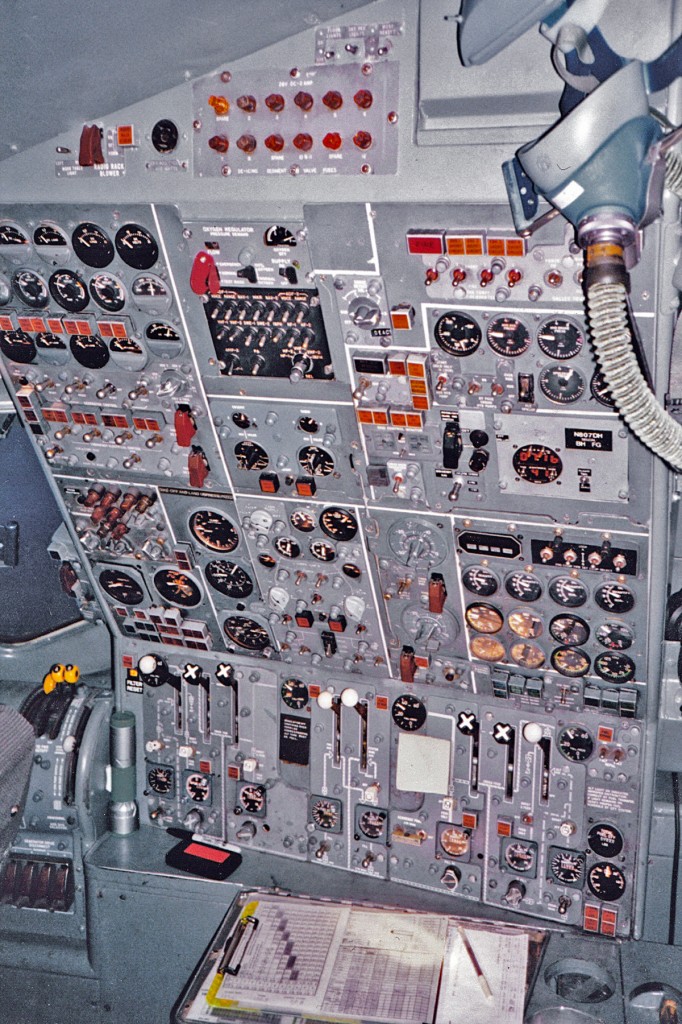
You can see the calculator in the picture below, taken in 1998. No, that’s not a U-boat circa 1944; it’s the flight engineer’s station of a Douglas DC-8. This was my office for about four years, shuttling cargo to and from Europe and across the U.S. The calculator is on the ledge, lower left. Notice it has an orange sticker on its case. I added the sticker for the same reason that I use a bright red bumper on my iPhone: to keep me from leaving it behind. So much for bright ideas, literally.
The calculator was a necessary instrument on the ancient Douglas. The weight, balance, and fuel calculations were all done by hand. It was simple arithmetic, but these were big, six-digit numbers. Not so much on the 767. It’s the dispatchers, loaders and planners who do all the serious number-crunching. They upload the results to us and we plug them in. About the only things we calculate manually are the waypoint crossing times and maybe the start/end times of our crew rest breaks. This is hardly anything technical; they’re just figures of convenience jotted down in the margins of the flight plan, requiring nothing more than adding or subtracting a few simple numbers.