Daily Shaarli
April 23, 2023

RFK Jr., in his recent announcement of his candidacy for president, declared that he was going to do something truly radical if elected president: tell the truth, no matter how uncomfortable or unpopular //
The idea of a politician being held to such a standard shouldn’t be radical, but it absolutely is. At this point, we simply take it for granted that if a government actor’s lips are moving, he’s probably lying. The only questions are how much of what he’s saying is exaggerated, distorted, or outright fabricated, and for what purpose?
And because the corporate media that is supposed to expose and chronicle politicans’ lies is almost always in on the deception itself, the onus falls on the individual or a trusted independent media source to sort fact from fiction. What this leads to is a devastating decay in trust in government and an erosion of civic engagement of the sort seen in Eastern Europe in the heyday of Soviet communism.
“The rules are simple: they lie to us, we know they’re lying, they know we know they’re lying but they keep lying anyway, and we keep pretending to believe them.”
– Elena Gorokhova, A Mountain of Crumbs

Letting the calendar cycle for 45 years gives each planet a chance to complete a synodic cycle. //
"By increasing the calendar length to 20 periods of 819-days a pattern emerges in which the synodic periods of all the visible planets commensurate with station points in the larger 819-day calendar," the researchers wrote.
The math appears to bear that out. NASA reckons Mercury's synodic period is 115.88 days, but if we allow the ancient Mayans some leniency due to their lack of advanced scientific instruments and say it's 117 days, you can get exactly seven periods on the calendar.
The other planets visible from Earth and known to the Mayans – Venus, Mars, Jupiter and Saturn – all have similar mathematical matches when the calendar is allowed to make multiple cycles. Mars, which has the longest synodic period at 780 days, takes 21 periods to fit exactly into 20 cycles, both of which have 16,380 days, just shy of 45 years.


This repository contains scripts to set up my configuration, tools and environment on all of my computers. The scope is limited to tools and configuration specific to my user account; I maintain separate provisioning for fixed-purpose computers.
With it, I can be productive within 10 minutes of encountering a new or re-installed PC.
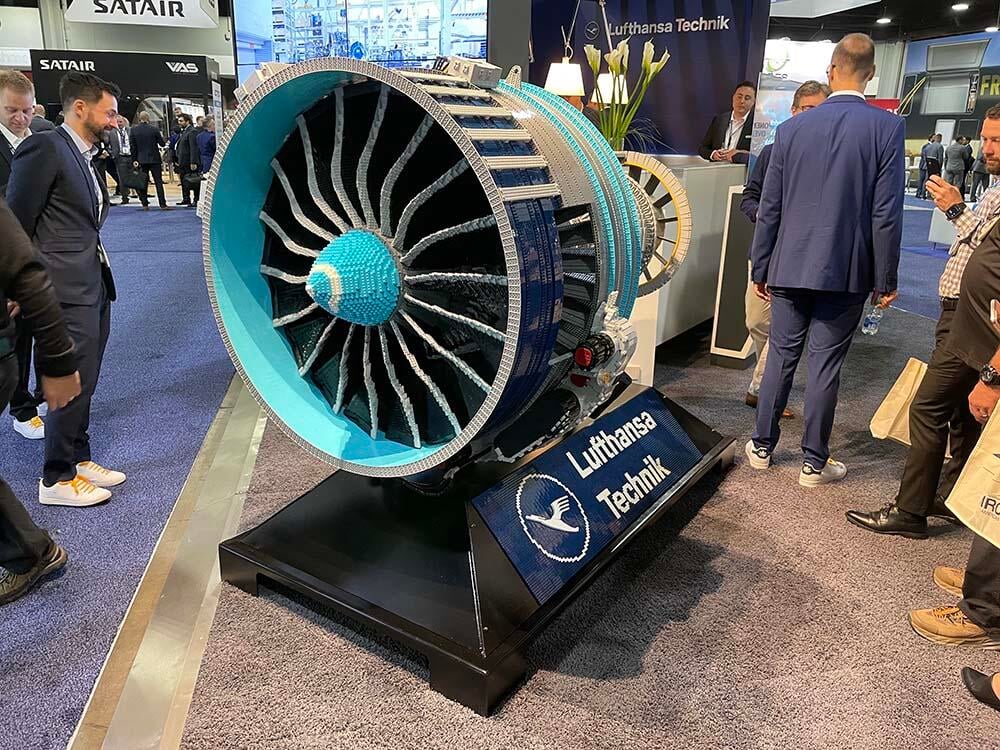
ATLANTA—A CFM Leap-1B engine made out of Lego bricks is making its worldwide public debut on April 18 at Lufthansa Technik’s booth (#1421) at MRO Americas.
The engine, built at 60% of the powerplant's actual size, is made of some 400,000 Lego pieces and weighs 450 kg (992 lb.). It measures 105.6 cm by 1.88 cm by 145 cm.
The idea came from a Lufthansa Technik employee who likes to build things out of Lego and his son, “who built the first Lego engines at a smaller scale for giveaways,” says Derrick Siebert, Lufthansa Technik’s VP of commercial engine services. “These were very well received from customers, and that is where the idea generated,” he adds.

Yesterday I wrote about the first launch of Space X’s Starship, the most powerful rocket ever built. There was one particular clip which seemed to show a bunch of debris flying at the camera as the rocket was lifting off. Here’s the clip.

Thought Icelandic glacier water was rare? How about chugging down some Moon water. //
Scientists in China have found glass beads contained in lunar soil might hold enough water to provide a resource for future lunar missions.
The results, published in Nature Geoscience this week, stem from data collected by China's Chang'e-5 mission, and suggest the Moon's surface holds much more trapped water than previously thought and the liquid compound vital to continuing life could be relatively easy to extract.
Small glass beads created when meteorites smash into the lunar surface have long been considered a candidate for water storage. Using samples from the Apollo 11 mission, a US study published in 2012 found between 200 and 300 parts per million of water and hydroxyl (OH) in the glass beads they contained. //
Water made it into the beads via the solar winds, the reasoning goes. Solar winds are a plasma emitted from the sun containing hydrogen ions. On earth, they cause the aurora borealis and aurora australis, owing to an interaction with the Earth's magnetic field in the upper atmosphere. As the Moon has no magnetic field, the solar winds can reach its surface and interact with minerals in the soils containing oxygen. Because the solar wind is always, erm, blowing, the water in the beads is replenished.

Salat did not immediately realize that he was witnessing a “SpaceX Spiral.” As noted by SpaceWeather, three hours earlier SpaceX launched 51 small satellites on a Falcon 9 rocket from California’s Vandenberg Space Force Base some 3,000 miles (4,828 kilometers) away. //
An all-sky camera at the University of Alaska’s Poker Flat Research Range also captured the strange whirlpool on Saturday evening. //
SpaceX rockets are designed to land back on Earth but the second stage of the Falcon 9 does not parachute down to the ground. Instead, it burns up in the atmosphere but before doing so it vents its unused fuel which will often take the form of a stunning spiral. //
“I will say I loved the wonderment of not knowing what it was. The auroras kept on dancing so it was hours before I had time to research and try figuring out this unique phenomenon I had witnessed.
“Those were the best hours of blissful bewilderment.”

Make yourself a temporary alias for the SD card, test it, then use that so you can’t accidentally get the wrong device. e.g.
MY_SD=/dev/sdc1
ls $MY_SD
dd if=disk.img of=$MY_SD
In this example “ls” is not really a good test, but I’m on Mac so I’m not sure if “diskutil info $MY_SD” would work for you, but sub in any command that you feel gives the confidence that MY_SD points in the right direction. //
If you´re always using the same removable medium, it´s easy to set an udev rule that match this particular device and symlinks (or even rename) it to /dev/whatyouwant
Or even more globally match any USB attached mass storage, for example /dev/sdxn becomes /dev/extUSBxn if you want to.

VSI releases OpenVMS 9.2-1 and x86 hobby licenses //
VMS Software Inc (VSI) has opened its hobbyist licensing scheme for the x86-64 version of one of the most reliable OSes in the business.
The slow-but-steady migration of OpenVMS onto commodity x86 kit has passed a couple of significant milestones. A year ago, we covered the release of OpenVMS 9.2, the first production-ready version of the OS for x86-64 kit. In that story we mentioned that the VMS equivalent of a point release was coming, probably at the end of 2022. Well, it's here, and there is also a way to get hold of the new OS and try it for yourself.
Progress is slow, but that is a good thing: this is one of the most reliable and stable OSes in the IT industry. A measured, thoroughly tested release cycle is what you want when some clusters have uptimes measured in decades.
Last month, HP spin-off VMS Software Inc. started the field test of OpenVMS E9.2-1. This version means two significant new milestones for this 46-year-old enterprise OS. It's the first update for the new x86-64 edition: if you were running 9.2 on Intel-powered tin, you can get the 9.2-1 update and do an in-place upgrade.

firmware is weirder than we give it credit for. It's even hard to say exactly what it is.
That used to be easy – firmware was software built into hardware (don't mention microcode.) In the days when that meant small expensive ROM chips, only a tiny part of a device's working software could be stored that way, in general just the low-level routines that directly operated the hardware and presented APIs to software that would be loaded in later. Now many devices have enough system flash on board to hold the complete stack, firmware now includes complete operating systems and has come to mean that software at the heart of your technology that controls its behavior and which you can't just load in as an app.
This somewhat shadowy status has consequences. For a start, it has virtually no consumer market. Nobody goes out and buys new firmware; //
No illicit market exists to cream off revenues.
While companies can buy in firmware from other companies, more often, as with MSI, you're a hardware company writing your own firmware. //
So there's no market in stolen firmware, and not much to be gained by keeping it secret anyway. So why lock it down? //
So unlocking firmware makes it more secure, not less. It makes devices more useful, not less. It creates more innovation, not less. And open source firmware is theft-proof; nobody can steal what you're giving away. //
In fact, it's probably time to ditch the idea of firmware as a magical chimaera too dangerous to be freed. The idea only made sense when hardware imposed far more limits on computer architecture. Its continued existence doesn't benefit anyone – manufacturers, users, innovators or the environment. As one of the last ways left to lock people out from their own devices, it's a barrier, not a shield. Publish the code. Open the specs. There's no firm foundation for firmware any more.
[Callan] built a script which runs on every new server he spins up which selects two random colors, checks that they contrast well with each other, don’t create problems for the colorblind, and then applies them to the bash prompt.