The 30-foot-long, robotic, X-37B military ship — which has gained fame both for its secret missions as well as its ability to stay in orbit for so long — ended its most recent trip at NASA’s Kennedy Space Center in Florida on Saturday, according to Space Force and USA Today. //
The unmanned little spacecraft, which looks like a mini-shuttle, spent a record-breaking 908 days in orbit, or 118 days more than its previous record, USA Today said.
The reusable Boeing vehicle, now done with its sixth mission, has traveled 1.3 billion miles over the course of 3,774 days in space. It has been whizzing around Earth on various trips since 2010.
While X-37B’s primary missions are mainly secretive, it does perform secondary tasks that are publicized, the outlet said.
Several NASA experiments were completed during the record-breaking mission, the military Space Force said in a statement.


Traditional backup tools can mostly be subdivided by the following characteristics:
-
file-based vs. image-based
Image-based solutions make sure everything is backed up, but are potentially difficult to restore on other (less powerful) hardware. Additionally, creating images by using traditional tools like dd requires the disk that is being backed up to be unmounted (to avoid consistency issues). This makes image-based backups better suited for filesystems that allow doing advanced operations like snapshots or zfs send-style images that contain a consistent snapshot of the data of interest. For file-based tools there is also a distinction between tools that exactly replicate the source file structure in the backup target (e.g. rsync or rdiff-backup) and tools that use an archive format to store backup contents (tar). -
networked vs. single-host
Networked solutions allow backing up multiple hosts and to some extent allow for centralized administration. Traditionally, a dedicated client is required to be installed on all machines to be backed up. Networked solutions can act pull-based (server gets backups from the clients) or push-based (client sends backup to server). Single-Host solutions consist of a single tool that is being invoked to backup data from the current host to a target storage. As this target storage can be a network target, the distinction between networked and single-host solutions is not exactly clear. -
incremental vs. full
Traditionally, tools either do an actual 1:1 copy (full backup) or copy “just the differences“ which can mean anything from “copy all changed files” to “copy changes from within files”. Incremental schemes allow multiple backup states to be kept without needing much disk space. However, traditional tools require that another full backup be made in order to free space used by previous changes.
Modern tools mostly advance things on the incremental vs. full front by acting incremental forever without the negative impacts that such a scheme has when realized with traditional tools. Additionally, modern tools mostly rely on their own/custom archival format. While this may seem like a step back from tools that replicate the file structure, there are numerous potential advantages to be taken from this:
This repo aims to compare different backup solutions among:
borg backup
bupstash
restic
kopia
duplicacy
your tool (PRs to support new backup tools are welcome)
The idea is to have a script that executes all backup programs on the same datasets.
Modern Authentication is an umbrella term originally defined by Microsoft, but many other companies also use it to describe a set of the following:
- Authentication methods (authentication = how something/somebody logs in to a system)
- Authorization methods (authorization = mechanisms that make sure you do not have full access to something by default)
- Conditional access policies (policies which define the conditions under which certain additional steps have to be taken in order to log into a system)
Authorization and authentication methods are standardized in the digital world. The industry standard for authorization is OAuth2. For authentication there is no industry standard, but the standard which is most widely used is OpenID Connect. Although they serve different purposes, these standards are very much related from a technology standpoint. The OpenID Connect protocol suite extends the OAuth protocol and they are based on the same technologies. OAuth was never designed to authenticate users or persons, but only services. That is why OpenID Connect was created.
How would Modern Authentication look like in our airport analogy? With Modern Authentication, the procedure seems quite familiar: You fly abroad, leave the plane and go to the security officer at the border control. The officer asks to see your passport on which he can find all the important information needed to identify who you are and where you are from. This information is protected by anti-forgery mechanisms. In the digital word, the passport is what we call an ID token. This token contains important information: who you are, who created the token, how long it is valid, etc.
Where Does Multi-Factor Authentication (MFA) Fit Into the Mold?
Two-Factor Authentication (2FA) and Multi-Factor Authentication (MFA) are a part of the authentication process. The process is as follows: You as a user connect to your identity provider who needs to validate that it is really you trying to connect. Depending on the conditional access policies which are defined by the administrator, your identity provider might ask you for further information. If he believes that just entering your credentials is not enough to authenticate you, for example when you are connecting from an unknown network, he may ask you for additional information, for instance a code which is sent to your mobile phone. Microsoft has implemented this in a very dynamic way. Their systems continuously learn and decide what is a secure system and what is not.
Congratulations!
You are about to get married and begin the adventure of a lifetime!
Together, you are deciding which Method of Natural Family Planning (NFP) or Fertility Awareness Method (FAM) best suits your values, lifestyle, and gives you the confidence you are looking for in avoiding pregnancy (and for achieving pregnancy when you’re ready).
Finding the right method is key for becoming confident in practicing NFP and enjoying everything this lifestyle has to offer you as a couple.
At Natural Womanhood we have supported thousands of couples in this journey. We understand your questions and needs, and we want to make this important decision easier for you.
HISTORY
@HISTORY
·
Follow
Official
What they uncover off the coast of Florida, outside of the Triangle, marks the first discovery of wreckage from the 1986 Space Shuttle Challenger in more than 25 years.
While countries with tens of millions of citizens, such as France and Brazil, are able to tabulate nationwide election results within 24 hours, the Grand Canyon State has continued to disrespect its voters by repeatedly leaving them in limbo and turning what’s supposed to be Election Day into “election season.” International election observers have regularly pointed to delayed election results as one of several warning signs of incompetent election administration, and although that doesn’t mean there was impropriety in this year’s Arizona elections, the failure to tabulate votes in a timely and efficient manner does nothing but undermine voters’ confidence in the electoral process.
When I was writing the zine How DNS Works earlier this year, someone asked me – why do people sometimes put a dot at the end of a domain name? //
almost every line starts with a ;;. What’s up with that? Well ; is the comment character in zone files!
So I think the reason that dig prints out its output in this weird way is so that if you wanted, you could just paste this into a zone file and have it work without any changes.
This also explains why there’s a . at the end of example.com. – zone files require a trailing dot at the end of a domain name (because otherwise they’re interpreted as being relative to the zone). So dig does too. //
There are two contexts where domain names are modified and get something else added to the end:
- in a zone file for example.com, grapefruit get translated to grapefruit.example.com
- on my local network (with my computer configured to use the search domain lan), grapefruit gets translated to grapefruit.lan
So because domain names can actually be translated to something else in some cases, people like to put a "." at the end to communicate “THIS IS THE DOMAIN NAME, NOTHING GETS ADDED AT THE END, THIS IS THE WHOLE THING”. Because otherwise it can get confusing.
The technical term for “THIS IS THE WHOLE THING” is “fully qualified domain name” or “FQDN”. So google.com. is a fully qualified domain name, and google.com isn’t.
anon-t26i
2 hours ago edited
“Republicans are a small government group with leanings toward capitalist economics..” No they are not. Deficit spending – Republican. New federal agencies? Republican. Destruction of habeas corpus? You guessed.
Mini Refresher Course partial list: Herbert Hoover increased federal spending 38%, passed the Agricultural Marketing Act (welfare for farmers) and the Reconstruction Finance Corporation (pork and corporate welfare) as well as increased taxes.
Eisenhower: Increased federal spending 30 percent, Created Department of Health, Education, & Welfare (and spending), Started American involvement in Vietnam, Created NASA
Richard Nixon: Increased federal spending 70 percent, Created EPA, OSHA, and CPSC, Imposed price and wage controls, Made your 1968 dollar worth just 78 cents by the time he left office.
Gerald Ford: decreased the value of the dollar by 8 cents while increasing federal spending.
George Herbert Walker Bush: Increased federal spending 12 percent, Managed to knock 13 cents off the value of your dollar in just four years, he was kind of like Obama’s “you can keep your doctor” with his “no new taxes”.
GW Bush: Expanded the size of government with the Department of Homeland Security, increased federal spending by 48.6 percent and shot habeas corpus to heck. And let us not forget how he ignored the warning signs, from the FBI no less, of 911 and then involved us in a unprovoked attack of a sovereign state. What is the difference between a Republican and a Democrat? You know the answer.
Zelensky married a non-Jewish woman who was baptized, and he and his wife baptized their two children in the Greek Orthodox tradition, according to press reports. Boleslav Kapulkin, the spokesman for Chabad Lubavitch in Odessa, Ukraine, was even under the impression that Zelensky himself had converted to Christianity. Eduard Dolinsky, executive director of the Ukrainian Jewish Committee, went further. He attested that Zelensky is “a Ukrainian with Jewish ancestry; he’s not a member of the Jewish community, he’s not religious, doesn’t keep Jewish traditions and never speaks of himself as a Jew.”
There’s a long-running and complex debate over what constitutes Jewish identity. But there’s no question that Zelensky’s life choices have been inimical to the survival of the Jewish people and the Jewish faith. //
He also slammed, of all nations, lo and behold, Israel for refusing to arm Ukraine. (Israel hasn’t armed Russia either.) Now there is reporting that Zelensky is pushing the White House to pressure Israel.
Worse still, Ukraine, under Zelensky, has been rather hostile to Israel at the United Nations, the international forum where the Jewish state has been under sustained assault for decades. According to UN Watch, in a total of 122 resolutions involving Israel, Ukraine has voted against Israel in 95 and abstained in 27. That means it did not vote in favor of Israel once. Yet Zelensky continues to make demands of the Jewish state, which must deal with a Russian presence in neighboring Syria, where Israel conducts counterterrorism operations against Islamic extremists. //
So what are we to make of the enthusiasm for Zelensky the “Jewish hero,” and, moreover, the fact that it’s predominantly on the left? The answer is simple. Zelensky represents not Judaism as it has been known for thousands of years, but the left’s own brand of Judaism. The progressive brand of religion demotes the “outmoded” pillars of authentic faith — custom, tradition, ritual, faith, community, and family. //
The left has long wanted Judeo-Christian civilization erased from the face of the planet. From that perspective, it’s easy to see why so many liberals and progressives cheer on an individual wholly detached from anything resembling revealed religion. Sure, Zelensky is a hero to many. If anything, he’s a hero who’s a Jew — not a “Jewish hero.” That’s a distinction worth making.
2020-05-27, 20:32
I would just like to add one more voice (mine) to add to the weight of importance of EDL files. I use this feature in the exact same way, and was having the exact same issue. I'm glad I found this thread, I deleted the comments sections that were being made in the EDL file and it fixed the issue. Thank you!
I dunno if Kodi necessarily needs to be fixed or maybe just tweaking the very dated add-on - mute profanity would be the easier solution.
The Navy Isn’t Prepared To Face The Growing Diesel Submarine Threat
A veteran submarine hunter explains how the proliferation of ever more capable diesel-electric submarines is a major problem for the U.S. Navy.
the flexi disc made its first (and last) appearance in Spectrum, accompanying an article entitled “Voice signals: bit-by-bit,” written by Jon W. Bayless, S. Joseph Campanella, and A.J. Goldberg. The piece provided an overview of the emerging field of voice digitization, which the authors suggested might alleviate the stress placed on global telecommunications networks by increased demand for long-distance and overseas phone calls. It was a prescient prediction, given that analog telephones are close to becoming extinct today. //
Most of the article is devoted to technical descriptions of these competing methods, but the authors realized that a written summary could not fully convey the experience of listening to digitized voices. As a result, they collaborated with colleagues at academic, military, and industrial laboratories to record samples of various speech digitization techniques. The recording lasts just under six minutes and contains fourteen audio excerpts, each consisting of a few sentences that were generated using different methods and sampling rates. The resulting passages are frequently nonsensical, but the words themselves are less important than any noise or distortion resulting from the digitization process.
This flexi disc is, in effect, an audio time capsule preserving the state of speech digitization research in the early 1970s. //
There is something elegantly recursive about watching this flexi disc revolve on the turntable and hearing the resulting stream of sample sentences. After all, this is a digital video of an analog record that contains samples of digitized human speech. Variations of the PCM and vocoder techniques that are being demonstrated here are still used to encode audio signals today.
Beyond its significance as an artifact of the early days of digital audio, this flexi disc is also a reminder of the ongoing value of libraries and archives to 21st century researchers. Databases like IEEE Xplore allow users to review a vast amount of scientific and technical literature, but they are not comprehensive. There are still plenty of books and journals that have never been scanned, not to mention multimedia materials that might be more complicated to digitize or distribute. Whether one considers audio recordings or scarcely-held publications, sometimes there is just no substitute for consulting the original source.
How to Remove File Association Windows 10
To remove file type association in Windows 10, you can go to modify Windows Registry. Here is a simple guide and you can refer to it to remove file type association of the file extension you want.
- Press Windows + R to open Run window.
- Input regedit and click OK button to launch Registry Editor.
- Copy-paste the following path to the address bar and press Enter: Computer\HKEY_CURRENT_USER\Software\Microsoft\Windows\CurrentVersion\Explorer\FileExts.
- Under FileExts key, find the file extension you want to remove file association for.
- Right click on the FileExtension on the left side of the screen, choose Export. Save as something like "file ext java.reg" (use the .reg extension).
- Right-click the file extension on the left side of the screen and choose Delete.
- To reverse the delete, double-click the file you saved.
WHAT BOEING NEEDS to build isn’t a fancy new long-range widebody. What it needs to build is a replacement for the 757.
When it debuted in the early 1980s, the twin-engined 757 was ahead of its time, and it went on to sell quite well until the production line closed fifteen years ago. By now the plane is — or should be — obsolete. Indeed it’s rare to spot a 757 outside of the United States. But here at home it remains popular, a mainstay of the fleets at United, Delta, FedEx and UPS, who together operate over two-hundred of them. They’ve kept the plane on their rosters so long for good reason: its capabilities are unmatched, and there’s nothing that can replace it.
The 757 is maybe the most versatile jetliner Boeing has ever built — a medium-capacity, high-performing plane that is able to turn a profit on both short and longer-haul routes — domestic or international; across the Mississippi or across the North Atlantic. The 757 makes money flying between New York and Europe, and also between Atlanta and Jacksonville. United and Delta have flown 757s from their East Coast gateways on eight-hour services to Ireland, Scandinavia, and even Africa. You’ll also see it on 60-minute segments into Kansas City, Cleveland, and Tampa.
Along the way, it meets every operational challenge. Short runway? Stiff headwinds? Full payload? No problem. With 180 passengers, the plane can safely depart from a short runway, climb directly to cruise altitude, and fly clear across the country — or the ocean. Nothing else can do that.
November 12, 2021
WE MADE IT. I had my doubts, but we pulled it off.
Today marks the 20th anniversary of the crash of American Airlines flight 587 in New York City. We have now gone twenty full years since the last large-scale crash involving a major U.S. carrier. This is by far the longest such streak ever.
On the sunny morning of November 12th, 2001, American 587, an Airbus A300 bound for the Dominican Republic, lifted off from runway 31L at Kennedy Airport. Seconds into its climb, the flight encountered wake turbulence spun from a Japan Airlines 747 that had departed a few minutes earlier. The wake itself was nothing deadly, but the first officer, Sten Molin, who was at the controls, overreacted, rapidly and repeatedly moving the widebody jet’s rudder from side to side, to maximum deflection. The rudder is a large hinged surface attached to the tail, used to help maintain lateral stability, and Molin was swinging it back and forth in a manner it wasn’t designed for. Planes can take a surprising amount of punishment, but airworthiness standards are not based on applications of such extreme force. In addition, the A300’s rudder controls were designed to be unusually sensitive, meaning that pilot inputs, even at low speeds, could be more severe than intended. In other words, the pilot didn’t realize the levels of stress he was putting on the aircraft. The vigor of his inputs caused the entire tail to fracture and fall off.
Quickly out of control, the plane plunged into the Belle Harbor neighborhood of Queens, a skinny section of Rockaway only a few blocks wide, with ocean on both sides. All 260 passengers and crew were killed, as were five people on the ground. It remains the second-deadliest aviation accident ever on U.S. soil, behind only that of American flight 191 at Chicago, in 1979. //
What we haven’t seen, however, is the kind of mega-crash that was once brutally routine, year after year. Take a look through the accident archives from 1970s through the 1990s. Seldom would a year go by without recording one or more front-page mishaps, with 100, 200, sometimes 300 (or more) people killed at a time. In the eighteen years prior to November, 2001, and not counting the September 11th attacks, the American legacies, which at the time included names like Pan Am, TWA and Eastern, suffered ten major crashes. The idea that we could span two full decades without such a disaster was once unthinkable.
It’s especially remarkable when you consider there are nearly twice as many planes, carrying twice as many people, as there were in 2001. Since then, the mainline American carriers have safety transported more than twenty billion passengers. Today they operate over four thousand Airbuses and Boeings between them, completing tens of thousands of flights weekly. The streak also takes in those dark years of the early 2000s, when pretty much all of the big carriers were in and out of bankruptcy, fighting for survival. Not to mention the dire challenges of the last twenty months, brought on by the COVID-19 pandemic. Best of times, worst of times. All it would have taken is one screw-up, one tragic mistake. Yet here we are. //
How we got here is mainly the result of better training, better technology, and the collaborative efforts of airlines, pilot groups, and regulators. We’ve engineered away what used to be the most common causes of accidents. Yes, we’ve been lucky too, and the lack of a headline tragedy does not mean we should rest on our laurels. Complacency is about the worst response we could have. Air safety is all about being proactive — even a little cynical. Our air traffic control system needs upgrades, our airports need investment. Terrorism and sabotage remain threats, and regulatory loopholes need closing. The saga of the 737 MAX has been a cautionary window into just how fortunate we’ve been, and exposed some glaring weaknesses.
Duly noted, but a congratulatory moment is, for today, well earned. This isn’t a minor story.
Almost nobody in the media is paying attention, trust me. Crashes, not an absence of them, make the news. Call it the silent anniversary, but there’s no overstating it: we have just passed one of the most significant milestones in commercial aviation history.
U.S. Airline Accidents With 50 or More Fatalities, by Year

THE TIMELINE of an aviation career, for some of us, is punctuated with dark occurrences. Furloughs, rejection letters, bankruptcies. And now, sigh, I’ve lost my beloved calculator.
I bought the thing 23 years ago, if I remember right, at the old Osco store on Highland Avenue near Davis Square. It was your basic flip-top model, dual solar and battery, with fat buttons and an oversized screen for better low-light viewing. I paid about four dollars for it.
When you own anything for 23 years, you grow fond of it. //
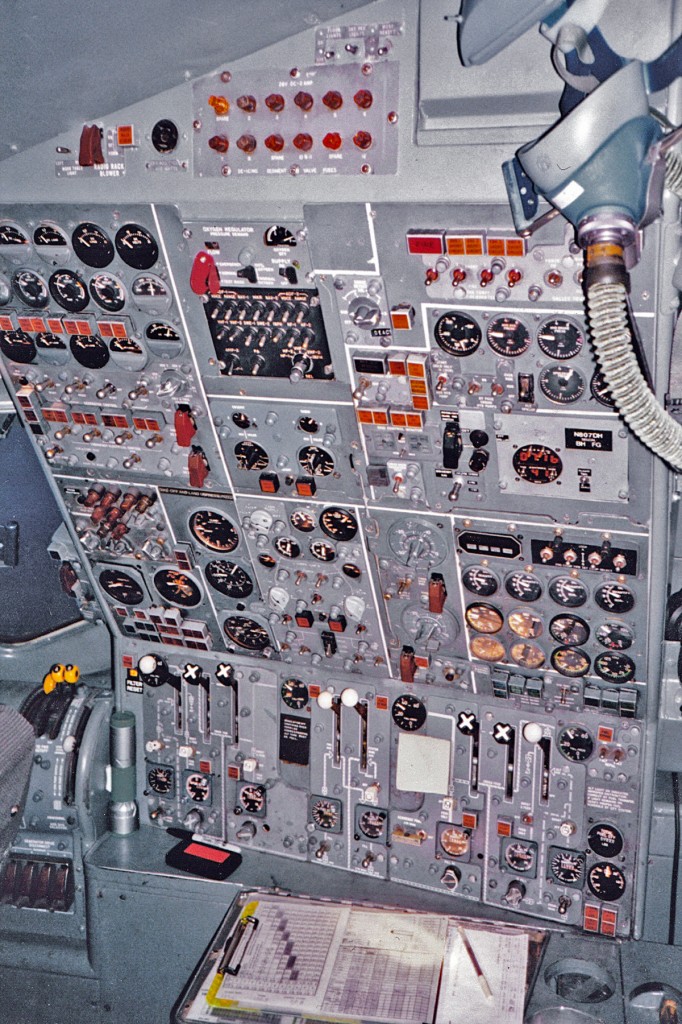
You can see the calculator in the picture below, taken in 1998. No, that’s not a U-boat circa 1944; it’s the flight engineer’s station of a Douglas DC-8. This was my office for about four years, shuttling cargo to and from Europe and across the U.S. The calculator is on the ledge, lower left. Notice it has an orange sticker on its case. I added the sticker for the same reason that I use a bright red bumper on my iPhone: to keep me from leaving it behind. So much for bright ideas, literally.
The calculator was a necessary instrument on the ancient Douglas. The weight, balance, and fuel calculations were all done by hand. It was simple arithmetic, but these were big, six-digit numbers. Not so much on the 767. It’s the dispatchers, loaders and planners who do all the serious number-crunching. They upload the results to us and we plug them in. About the only things we calculate manually are the waypoint crossing times and maybe the start/end times of our crew rest breaks. This is hardly anything technical; they’re just figures of convenience jotted down in the margins of the flight plan, requiring nothing more than adding or subtracting a few simple numbers.
LOTS GOING ON in the aviation world, beginning with the fact that I’ve retired my yellow highlighter. That’s right, I no longer carry a yellow highlighter as part of my pocket-flap ensemble of necessary cockpit gear.
Some months ago, you might recall, I talked about how, in the pocket of my polyester pilot shirt, you’ll always find three things: a ballpoint pen, a highlighter, and a red Sharpie. The highlighter I’d use for marking up the flight plan. I’d go through it page by page, striking the important parts in yellow: the flight time, the alternates, the dispatcher’s desk number, the airport elevations, deferred maintenance items, ETP coordinates, etc.
Well, now that our flight plans have gone digital, there’s not much call for this. We still carry a hard copy version of the flight plan, it’s true, but at this point it’s just a backup, rolled and stuffed into a cubby hole near the center pedestal. And you can’t use a highlighter, really, on an iPad.
What I’m not letting go of, on the other hand, is my beloved red Sharpie.
The Sharpie is my tool for what we’ll call high-emphasis tasks, the most critical of which is putting my initials on the cap of my water bottle, to keep other pilots from drinking from it (there are sometimes four of us up there). I also use it for my scratch-pad notes. When I’m in the first officer’s seat on the 767, there’s a clipboard along the bottom ledge of the window, just to my right. I keep a folded piece of paper there on which I jot down various quick-reference info — a distillation of bullet points from the flight plan.
I prepare the sheet prior to departure, while still at the gate, as part of my preflight prep. The photo up top is an example of a sheet used on a flight from Europe to the U.S. Here’s what it all means…
RNC Research
@RNCResearch
·
Follow
“Everything [Maggie Hassan] talks about wastes money, costs money, and takes money out of everyone’s pocket,” says @GenDonBolduc.
DON BOLDUC: Under Joe Biden and Maggie Hassan, “you can’t even buy a house, you can’t even rent property, you can’t even feed your children, you can’t even heat your home. That is the ultimate tax.” #NHSen
CLOSING STATEMENT from @GenDonBolduc: “You have to ask yourselves, Granite Staters, are you better off today than you were two years ago?”
“Two years ago, you were NOT making choices between heating and eating.” #NHSen
8:24 PM · Nov 2, 2022